
Have you noticed? Microstock industry has undergone dramatic changes in the recent years. And I don’t mean the seasonal style or color trends. Every part of the equation is changing: content, tools, contributors and agencies themselves. I hope you will find something interesting here that will give you some food for thought to answer the real question: “Is stock photography finally dead?”.
The authenticity and the AI-generated content tension
Audiences increasingly distrust advertising that looks AI-made and advertisement is the core buyer of the microstocks agencies. Therefore the “new trend”, if you want to call it so, is the “authenticity”. This does not mean buyers want every asset to look accidental or unpolished. It means over-perfect, culturally generic (aka Western), synthetic-looking work has become a liability when a brand needs credibility.
The time of making pictures perfect is gone. There was an amazing quote about this:
Floating rubbish and industrial runoff consistently out-sell clean postcard landscapes because news outlets, environmental reports, and policy briefs desperately need real documentation

Authenticity is also changing video demand. iStock stated that 71% of Gen Z and Millennials enjoy short-form social video, while Shutterstock and Pond5 briefs increasingly request vertical content. There’s no shortcut to making vertical video: cropping a horizontal 4K clip into a vertical frame retains only about 32% of its original pixels. Native 9:16 video for TikTok, Reels, and mobile ads is now a core format.
The same report cites iStock’s 2026 SMB research: six in ten people distrust advertising they suspect is AI-generated. The great irony is that in today’s world advertisers also want authentic content about AI itself (remember, most microstock buyers are advertisers and they need to show/document the reality of today’s world). Buyers need images of AI at work, but not another glowing robot hand hovering above a laptop.
Eastern Europe is no longer the top-1 supplier of stock assets
The link unfortunately does not exist, but I remember a blogpost in Shutterstock blog of ~10 years ago where they discussed some statistics of contributors and they discussed largest contributor countries: in the top-10 list they started discussion from position 3 out of 10 and one by one moved till 10, never mentioning who were 1 and 2. It was an unspoken “secret” that Ukraine and Russia were largest producers of stock content for a long time until Russia started the war on Ukraine.
This has changed lately as russians were restricted from getting their microstock money due to international sanctions for supporting the war and lots of Ukrainians’ lives were changed so drastically that microstocks were simply not on the table. Of course, there’re still many contributors from Eastern Europe, but they are no longer the leaders.
Spain and Indonesia took over as the largest historical producers of microstock content. This has implications because US/Canada are largest consumers of that content and while Spain is somewhat close culturally, Indonesia is a quite different state in terms of religion, culture and global way of life.
Decline of StockSubmitter has accelerated

Stock Submitter interface - well preserved in time
StockSubmitter, which was the market leader for a long time, is going extinct. I see 3 main recent causes here:
- While all microstock agencies are serving as either data farms for model providers or training the models themselves (like Adobe Firefly), access to data itself has become preciuos. And all agencies that have something to offer, have to protect it from interested parties from web scraping, blocking browser-dependent automation. And StockSubmitter, meaning the only useful part of it, is only a browser automation, which now has a lot of problems to deal with. Microstock Plus is in exactly the same boat.
- Growing irrelevance of most agencies (also discussed in this blogpost). The value of StockSubmitter, which was the submit function for many agencies, has became increasingly futile as
80%of those agencies bring exactly $0, next15%bring just so little that it’s financially damaging to even support them any longer. And the only5%that matter don’t require that much automation, in fact. - Somewhat relevant to the Eastern Europe topic, StockSubmitter being a Russian product that was serving mostly russians (which are now somewhat banned from Western microstocks), has taken a lot of financial damage.
Also there was a “forever” reason too: StockSubmitter’s usability has always sucked. It was, in fact, why Xpiks got so many users in the first place. Stock Submitter has existed for a long time and most of this time they invested into browser automation (which brought them a lot of money), but not into the usability of the app/platform itself and now they are paying even higher price for it.
The great consolidation of agencies is ongoing

And by “consolidation”, I don’t necessarily mean the failed merger between Shutterstock and Getty. Here consolidation means the death of unprofitable agencies and survival of the very few.
Apparently, it turns out running a large stock agency is inherently unprofitable (at least, in the current form). There can be many reasons for it: advertisement costs (bringing those customers that contributors need), legal costs (fighting IP infringement by contributors in courts), bloated management layers (e.g. Shutterstock). But finally it shows that you cannot just be unprofitable forever.
123RF, Dreamstime, YayImages and others may still produce occasional sales. That is not the same thing as earning a place in an active contributor workflow. The contributor analysis reports sub-$0.15 revenue per sale for 123RF and Dreamstime, alongside stagnant sales and reports of prolonged review queues.
From the large players, Adobe Stock is doing best here, but it’s currently “hidden” behind the corporate curtain how much of that is funded from their main businesses (Creative Cloud for enterprise buyers).
Wirestock and Freepik Magnific belong in a completely different category. The phrase “model-training factory” captures what they have become: perpetual sublicensing, work-for-hire treatment, background intellectual property (meaning pre-existing work a creator brings to the deal), and broad powers to act for the creator.
There’re a few more niche (and/or “premium”) agencies like those dedicated to drone video and book covers (sibling industry) and they are currently doing pretty OK too.
New AI keywording tools appear like mushrooms after the rain
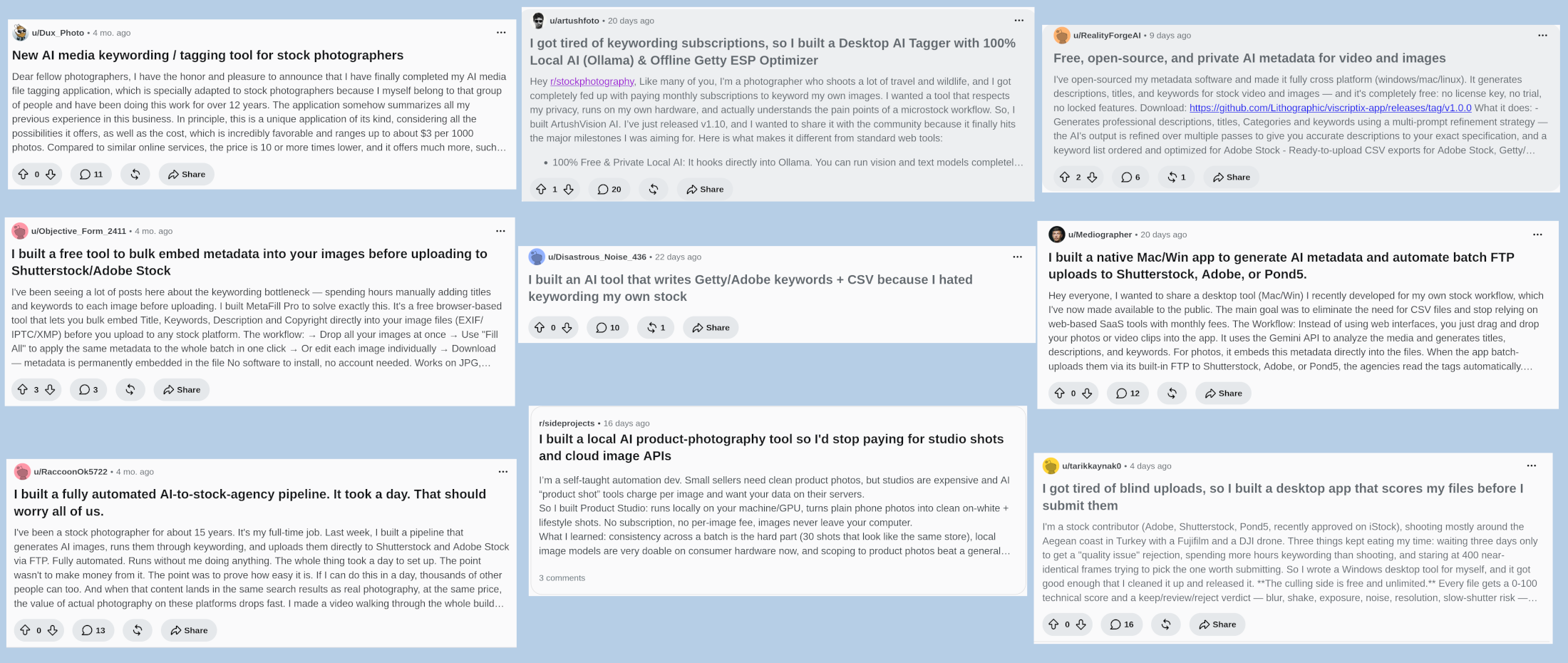
AI vibe-coded tools: Artush Photo AI, PixelKeyAI, MetaFill Pro, StockMeta and others
Almost every other week there’s an announcement on Reddit that someone made a new AI keywording tool to finally solve all of the pain of keywording manually.
It’s kind of great that people are discovering the power of vibe-coding (no irony here, it does feel great to be able to create something like that fast!). And I’m not even talking about how much of a slop most of these tools are. The main problem is: who will be paying for it?
In fact, it was possible to create a somewhat-working metadata tool already a few years ago with one prompt. Now, with new waaaay smarter models, it can be much cheaper to pay $20 for ChatGPT Pro and create a completely individual tool for yourself, rather than paying the poor author $5/month for their vision of such tool. And I’m not even taking here about running their business (obviously, they are yet to learn about B2C churn rates) - so there will be no one to support this tool and fix bugs for it to exist at least a few years.
The new old moats: niches and differentiation

Higher-barrier niches are becoming a survival mechanism. The old advice was to diversify. Shoot food, business, travel, backgrounds, lifestyle, and a little video so no category could hurt you too badly. That approach still has value, but it does not solve the main 2026 problem: generic supply has become almost infinite.
A useful niche now needs a moat. That moat can be access, credentials, local trust, specialized knowledge, equipment, permissions, or a location that cannot be recreated from a prompt.
Medical and cosmetic clinical care require access, release management, technical accuracy, and a professional environment. Infrastructure, pollution, waste processing, climate adaptation, and civic maintenance require physical proximity and a willingness to shoot useful subjects rather than conventionally beautiful ones.
This is also where editorial content is digged out from the grave of irrelevance to the status of “AI moat” (as AI cannot depict actual things exactly without hallucinations).
To be perfectly honest, this was always the case and niches/differentiation is included in the “trends of this decade” list because now it’s as dire as it has never been.
(Selective) Exclusivity returns
Exclusivity is returning as a selective portfolio decision. For years, contributors often treated exclusivity as an identity. You were exclusive to one agency or you were everywhere. In 2026, that binary is less useful.
Current strategy, mostly coined by Alex Rotenberg is to divide your assets as follows:
- Tier 1 (Core Volume Engine): Mirror all non-exclusive commercial photography, standard vectors, and AI-assisted concepts across Adobe Stock and Shutterstock. This maintains download velocity and secures annual AI dataset payouts.
- Tier 2 (High-RPS & Editorial Specialists): Upload specialized 4K aerial video and native vertical clips directly to Pond5. Send all local news, event, and real-world documentary editorial assets to Alamy and Shutterstock Editorial to benefit from fast review queues and higher per-sale payouts.
- Tier 3 (Pruning Strategy): Stop uploading to legacy low-performing agencies (123RF, Dreamstime) where review queues exceed reasonable limits and sales are negligible.
However, exclusivity is no longer a simple switch for every contributor who wants it. For example, iStock/Getty exclusivity has become more restrictive: there’s a formal application and vetting route that favors established contributors with proven premium lifestyle and people portfolios. Envato Market even ended its legacy exclusive author tiers on July 1, 2026.
Training Funds matter
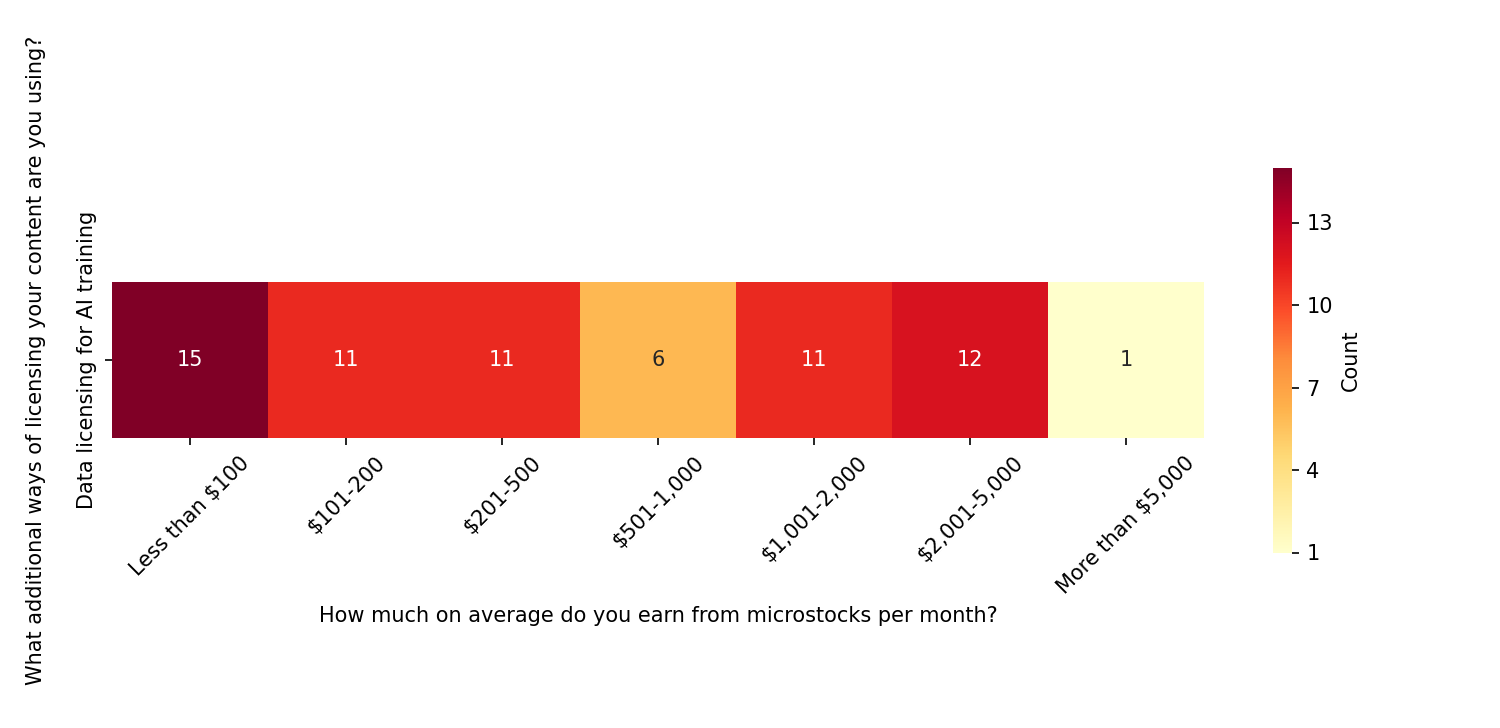
It's quite full for all earnings tiers (data from our 2024 survey)
AI-training payouts are becoming a larger part of contributor income because ordinary download income is under pressure. This is the most uncomfortable trend in the list because it can look like win and loss at the same time.
Adobe Firefly-related bonus payments, Shutterstock’s Contributor Fund and Data Marketplace payments, and Pond5 dataset earnings are examples of what companies are paying for training AI models on your assets. There are cases from Reddit where a quarterly data distribution exceeded a creator’s monthly subscription-download earnings (obviously, anecdotal, not a universal income benchmark). It still explains why these payouts matter more to portfolios experiencing lower conventional sales.
The danger, however, is treating a dataset payment as free money. Data licensing can change asset’s long-term value, especially if a portfolio is built on rare access, sensitive subjects, cultural specificity. A one-time or pooled payment may be attractive in a bad sales quarter. It may be far less attractive if the agreement grants broad, perpetual, or hard-to-revoke rights over the work and metadata.
The decision is not moral theater though. It can be smart to separate portfolios (like with tiered system discussed above) into separate accounts and not offer all goodies to feed the machine.
The decay of online contributor communities
It all started with Shutterstock closing quite active community forums during making their earnings restructuring in 2020, not wanting to deal with the outcry. Then some largest threads have migrated to Microstock Group forum, which for the next 5 years or so was getting increasingly deserted. Currently there’re many registered users there, but only a few “olds” are discussing anything (and occasional advertisement of a new AI keywording tool slips in). The remainders have moved to Facebook groups, Reddit and Telegram (for russians), but even there the conversations are not that active as they used to be 5 years ago.
Some of the larger microstock websites and blogs are now frozen in time, “waiting for their next chapter” in the Internet Archive:
- microstockinsider.com
- microstockman.com
- mystockphoto.org
- microstockdiaries.com
It is a good opportunity to invite you to subscribe to not-yet-dead Xpiks newsletter :)
Stock photography is (not) dead
Already being a meme (for good 10 years), that stock photography is dying, but is just not yet dead enough. At the same time, Steve Heap, who have just recently hit a $500,000 (half a million USD) lifetime stock photo earnings, calculated that his average price per download hasn’t changed that much over the years. Of course, it fluctuated a lot, but bounced back eventually. And while it’s not the case for everyone, it’s shocking in general because everyone would assume that average should have gone down.
This is supported by our 2024 survey:
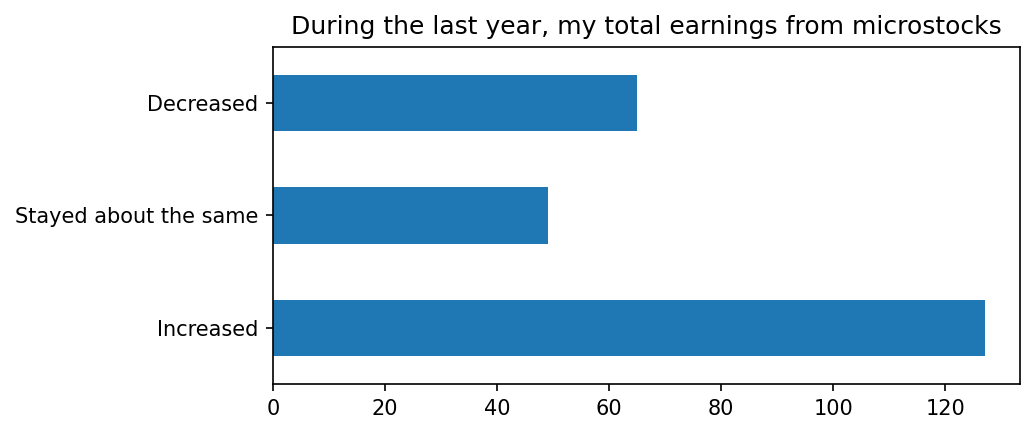
There're many for whom earnings have increased in 2024
However, there’s a huge group of users who recently joined to sell AI-generated content. Most of them don’t know much about cameras, drawing or art, but they know how to search for popular content on microstocks and how to prompt the model to do something similar. This group, in fact, was so huge, that agencies had to close the upload gates.
However, the implication for those who stayed (I mean, not changed a job) is that on Adobe Stock (the highest-paying agency at the moment) they now have to compete with a staggering amount of noise in search result. Noise of hundreds of thousands, if not millions, of lowish-quality AI-generated artworks.
So stock photography is not really dead. Just the old notion of it is. It has changed so drastically and if you are planning to just do the same you what did 5 or 10 years ago, you will be just spitting into the wind.