
If your microstock income is dropping, adding five more agencies to your upload workflow will not save you.
For years, the standard advice in the industry was rather simple: shoot more, upload everywhere, and let the sheer volume of your portfolio act as a hedge against any single agency lowering its rates. Platforms are changing shape. Adobe is actively turning stock assets into editable starting points. Shutterstock’s 2025 financials show their data, distribution, and services revenue growing 16% to $203.3M, while their core content business faces continued weakness.
The era of fighting AI on principle is over. The core decision for contributors now is how to build a portfolio that stays valuable inside a platform business that no longer depends entirely on licensing individual images. True microstock diversification is no longer a simple file-transfer exercise. It requires diversifying your content types and defending your visibility through precise, manual metadata.
The Mega-Merger and the Training Pipeline

The main risk to contributors today is not AI image generation itself, but the consolidation of a few mega-agencies that rewrite the rules to favor their data pipelines over your content licenses.
You might assume a merged platform landscape would mean access to more buyers. The reality is scale destroys creator leverage. Standard contributor agreements - written long before generative AI was a commercial reality - now function as blanket AI training consents thanks to broad “sublicensing” and “derivative works” clauses. Platforms are building their growth around packaged access and data products. Shutterstock’s standalone data business generated $120.3 million in 2024, up 15% year over year. When you treat your files as isolated artworks, you miss where platforms capture value.
The highly publicized AI contributor funds act as a goodwill gesture, not indexed compensation. A contributor whose image trains 10,000 AI generations receives the exact same fractional share of the fund as a contributor whose image the algorithm never touched. The payout does not track which assets contributed to which outputs. You cannot out-scale a platform that views your life’s work as bulk training material. TJ Leonard (Storyblock’s CEO) warned the industry about this exact leverage shift: contributors who rely on a single platform face devastating earnings risk when that platform inevitably changes its royalty structures to serve a new business model.
The volume fallacy
Distributing generic content across more platforms just makes you invisible in more places. Volume cannot fix a portfolio that lacks a clear commercial signal.
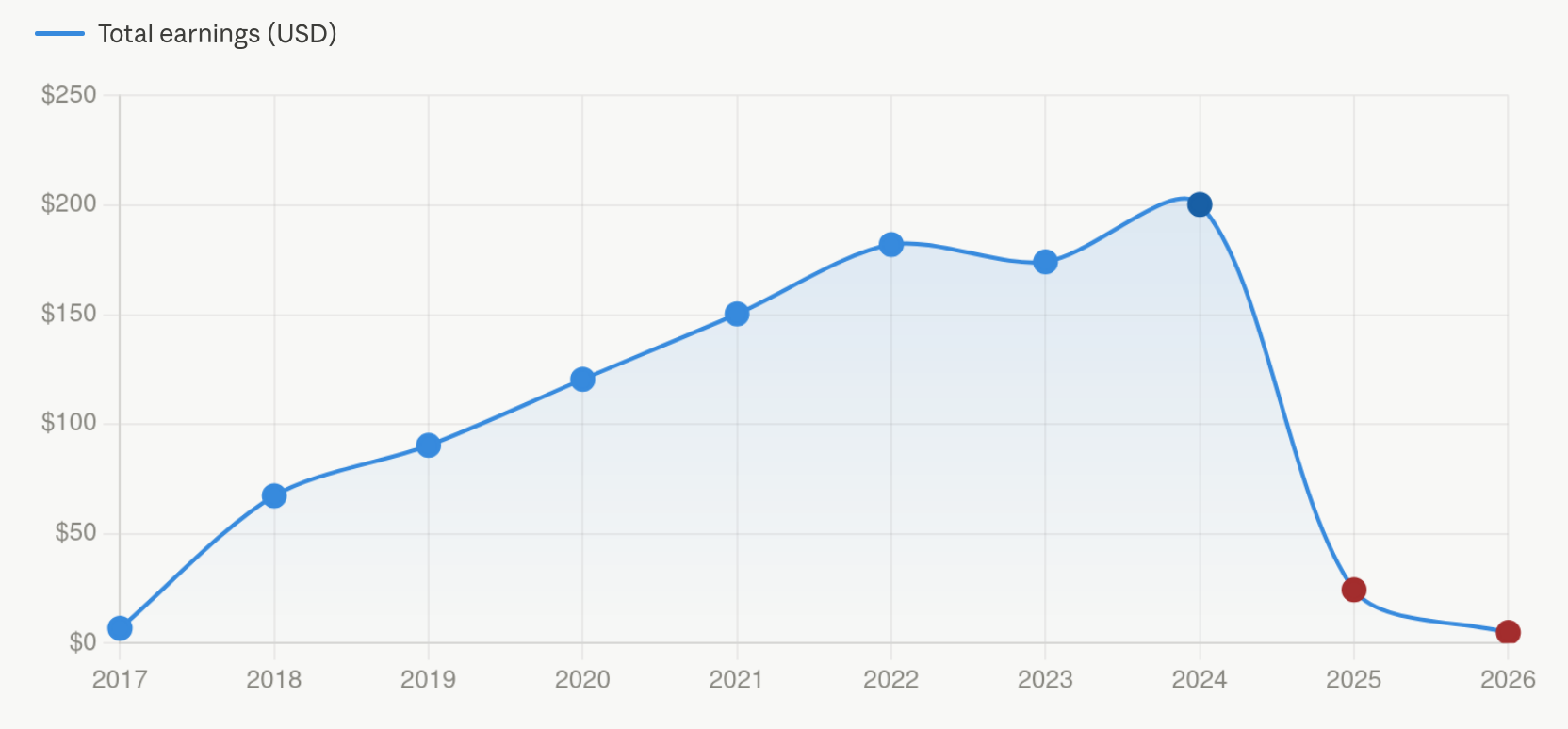
Self-reported earnings of one Reddit user
In April 2026, a contributor posted three years of earnings data across eight agencies to r/stockphotography. The data documented a consistent decline in per-download royalties across the board-Adobe Stock, Shutterstock, Alamy, Getty/iStock, Depositphotos, Pond5, 123RF, and Dreamstime. The same month, an Indonesian illustrator (@helloalzea) reported their income dropping from $300 a month per illustration pack to under $75, forcing them to close their microstock business entirely. Platforms reported growing AI product revenue in the exact same period.
AI can and will cannibalize some parts of the microstock industry (usually the lowest effort content). If your earnings chart looks similar to the above, maybe it’s time to think about it seriously. Just producing more of the same content class will not move the needle.
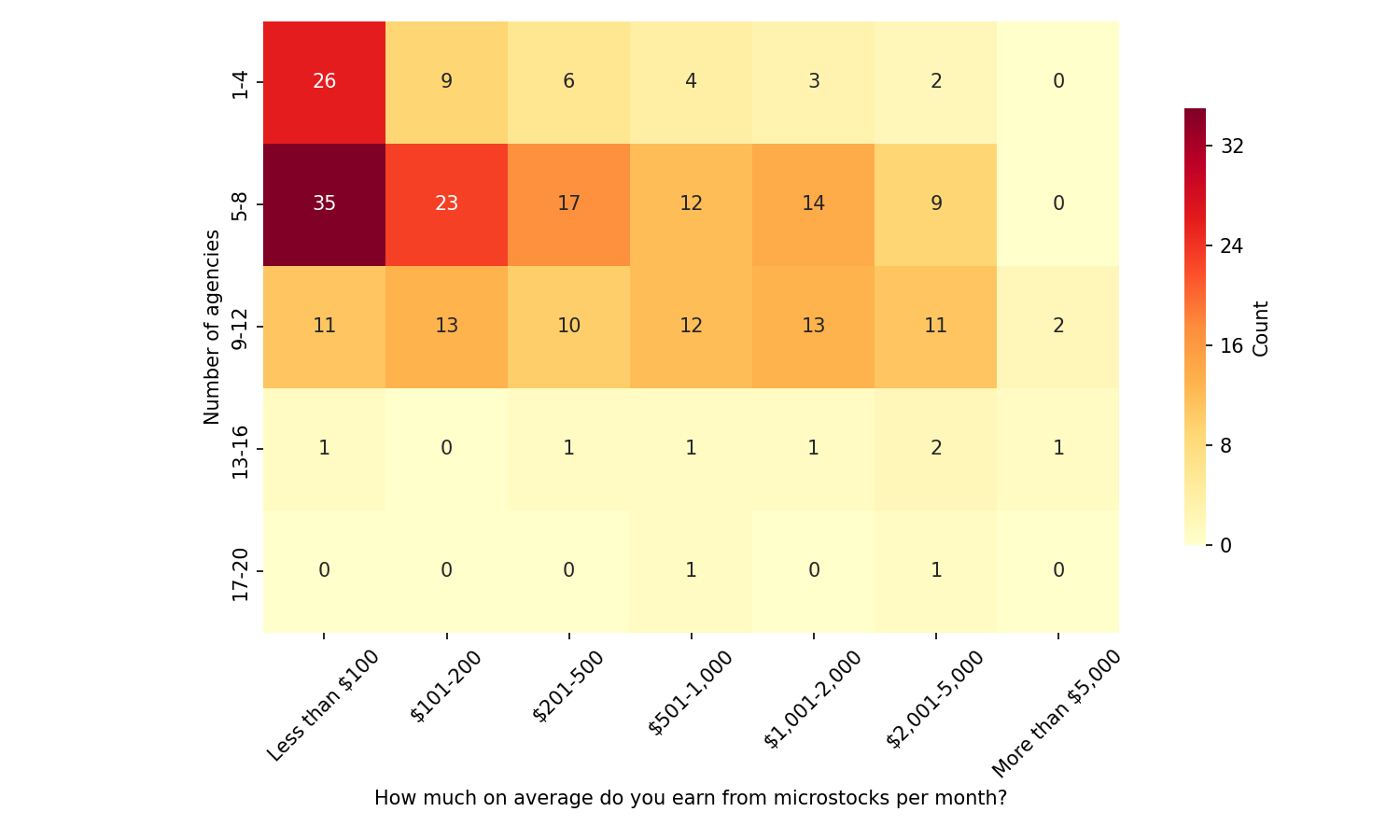
You might think this makes multi-agency distribution obsolete. It does not. Xpiks data from our 2024 microstock survey proves contributors who distribute portfolios across 5-8 microstocks earn more than exclusive artists. But distribution only multiplies the underlying value of your work. Adobe pays a better rate than Shutterstock or Pond5, yet a 33% royalty on an invisible file still earns exactly zero dollars.
High-barrier niches
To survive the shift from content to data, you must switch to content types that are difficult to mass-produce and impossible for AI to hallucinate accurately.
The market is choking on generic lifestyle shots and food of AI illustrations. Adobe Stock recently restricted accounts in the Indonesian market following a crackdown on AI asset farming: bulk uploads of generative images designed to earn passive income flood search results. If you upload a photo of a woman drinking coffee looking at a laptop, you compete against millions of identical, synthetically generated files.

Drone photo (or even video) of local landmarks: a 'double' high-effort content example
The actual definition of diversification today is moving into high-effort formats. Think drone video, medically accurate anatomical imagery, or localized editorial coverage. And in regulated niches, buyers still need signed model and property releases, indemnification, and legal cover that AI generators don’t reliably give. This is the moat that protects your portfolio from algorithm changes.
Niches with significant efforts
Niches that are less saturated due to logistical efforts:
- Astrophotography. It requires a sensitive camera, wide-aperture lens, and often a star-tracker or motorized mount to follow stars. Even with modest gear, exposures are long (tens of seconds) and need dark skies far from city lights. The biggest challenge is timing (clear skies, new moon) and stability (the camera must be absolutely still on a tripod for minutes). When possible, amateur astronomers loan gear or rent observatory time rather than owning expensive telescopes.
- Commercial lifestyle. Agencies have shifted their demand toward “authentic” lifestyle imagery, which ironically requires significant staging and investment to produce. Models with recognizable features must be cast to represent diverse ethnicities, ages, and abilities (which is something you might have access already). Large-scale shoots frequently require hair and makeup artists and might even need wardrobe stylists and gaffers.
- Aerial cinematography. The use of drones for commercial stock production is restricted by aviation authorities. Obtaining a license requires passing an exam (and maintaining the license too). Professional aerial stock requires high-end hardware and often involves secondary equipment for georeferencing and 3D mapping. You can read more in our blogpost.

- Fine Art. Technical aspect of taking pictures for Fine Art is perhaps not that much different from the stock ones, but the hussle of maintaining separate accounts, creating different metadata and working with it more like you work with your own shop (more of like Creative Market than like Shutterstock) is what keeping most contributors away from it. Read more from Steve Heap’s blogposts.
- Medical/Clinical documentation. Unlike generic lifestyle content, medical assets usually require the creator to possess some biological knowledge. Clinical photographers document patients in medical settings, documenting wounds, bruises, or surgical outcomes over time. This requires strict adherence to standardized viewpoints, lighting, and magnification ratios to ensure the images are clinically useful (and usable in the first place).
- Book cover photography. Similar to Fine Arts above, technically being similar, Book covers require a different mindset and management from the “usual” stock photography. A lot have been said in Alex Rotenberg’s blog posts on this topic, so I’ll send the curious reader there.

- Personal distribution. Very few pursue this path because the usual strategy is to focus on producing content and letting the agencies do the advertisement. Even less succeed here. But those who succeed, build their own distribution channel (albeit how small or large) and over the longer period of time it stacks. You can read about Luisa Fumi’s way or how few successful vector artists do it.
- Shooting with green screen. The cheapest way to travel (for the purpose of creating stock content) is to have a simple green screen setup at home. Work smart, not hard! Even with the basic setup and some Photoshop skills you can produce content that otherwise was inaccessible to you. Of course, it requires having that green screen in the first place and spending extra efforts for post-production.
Niches with extreme technological difficulties
Below are some of the most technologically-demanding niches:
- Underwater photography and videography. There are a lot of physical difficulties to overcome: the physical requirement of advanced diving proficiency, technical challenges of photography itself (water acts as a blue filter, stripping away the red, orange, and yellow parts of the spectrum). To produce commercially viable underwater pictures, you must restore the full color spectrum through artificial lighting. This is achieved using specialized underwater strobes or high-powered video lights mounted on adjustable arms. Underwater macro photography often requires very small apertures, such as f/22 to f/32, to combat the razor-thin depth of field inherent in high-magnification shots. As a workaround, some creators photograph aquarium setups or shallow-water pools to simulate reef scenes. For macro subjects (e.g. a diver’s coral models), one can shoot in a salt-water tank to avoid deep dives.

- Advanced video modes: 360-degree, parallax. Production of professional 360-degree video for stock platforms is technically complex due to the requirement for seamless spherical stitching and high-resolution output. While consumer 360 cameras are accessible, they rarely meet the technical standards required for comfortable viewing in virtual reality (VR) headsets, which typically demand a minimum of 8K resolution. Problems that you need to overcome include use of 6 to 24 individual sensors to minimize the overlap area at different angles, sustained write speeds of over
1,000 MB/sand advanced thermal regulation to prevent data corruption during long takes, and using powerful multi-GPU workstations for post-production. - “Extreme” macro photography (magnification to 20:1). Involves borrowing apparatus from microscopy to capture “larger than life” details. At these magnifications, the depth of field becomes so narrow that it may only cover a few micrometers of the subject’s surface. To achieve a sharp image of an entire subject, such as the compound eye of an insect, the photographer must take a “stack” of images - sometimes 100 or more - each at a slightly different focal plane. Vibration is the primary enemy of the extreme macro photographer (and many resort to electronic shutter to fight it).

- High-speed cinematography. The difficulty of this medium is that there’s an extreme loss of light that occurs as frame rates increase (at a capture rate of
1,000 fps, the effective shutter speed is1/2000of a second). Even in environments with abundant natural light, such as a sunny day, high-speed captures often appear underexposed without artificial supplementation. Examples are slow-motion videos or unique shots of lightnings, explosions, animal movements (e.g. hummingbird’s wings), breaking objects and/or some industrial processes.
Combinations
Of course, it goes beyond saying that you can combine the above and some people do:
- Underwater macro photography
- 360-degree astrophotography
- Drone local editorial videos
- Book covers made by drones/astro/macro
- (your other hobby) + art
Most interesting motives come from combining the fields where you know more than most people (e.g. other hobbies/professions of yourself or your friends/relatives) and your artistic skills. As the popular knowledge goes, it’s hard in life to be the top-1% in one thing, but it’s quite easy to be the top-1% in a combination of two things, in both of which you are top-10% or lower.
On automated AI keywording
Mass-producing content and blindly applying AI-generated keywords almost guarantees you will get lost in the noise.
Nobody wants to do the manual work of researching the exact keywords buyers actually type into a search bar and thinking about what content to produce. That is exactly why doing it yields better results. If you just generate the keywords and don’t even look at them, the photo or image will likely disappear in the pile of other search results that did the same.
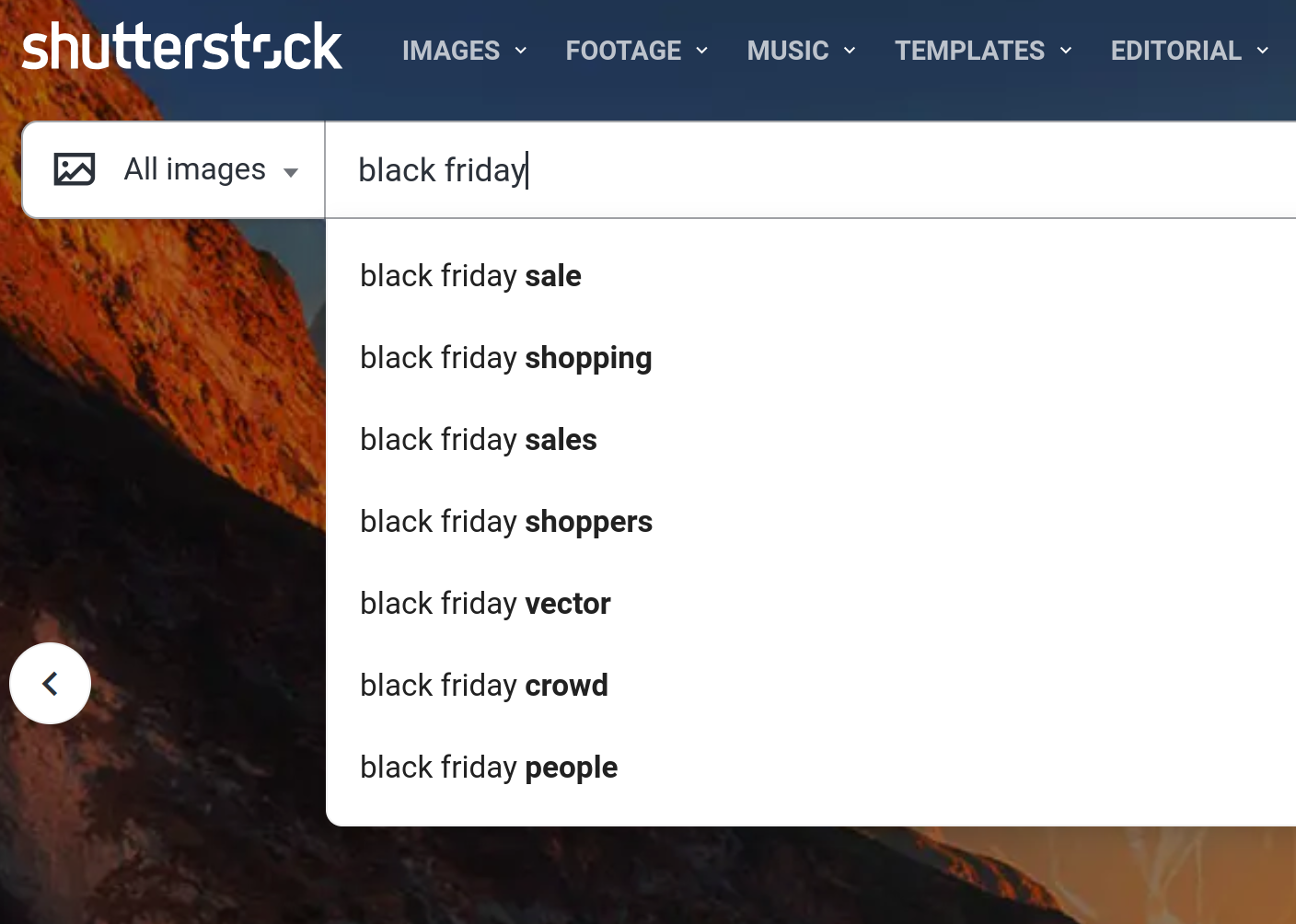
The most popular customer Black Friday queries in Shutterstock
Ironically, you don’t even need any kind of paid tools, just your time and willingness to investigate. The quickest way to know what works is to search it yourself. Run few of the most relevant short words and a few combo phrases through the stock site search bar and see which one brings up the most relevant results or the largest file count. Then ask a simple question: “does my artwork deserve to be there?”, is it valuable and/or different enough to matter to any buyer? If yes, by all means go ahead and work on it. No? - then you saved yourself hours or even days of wasted efforts.
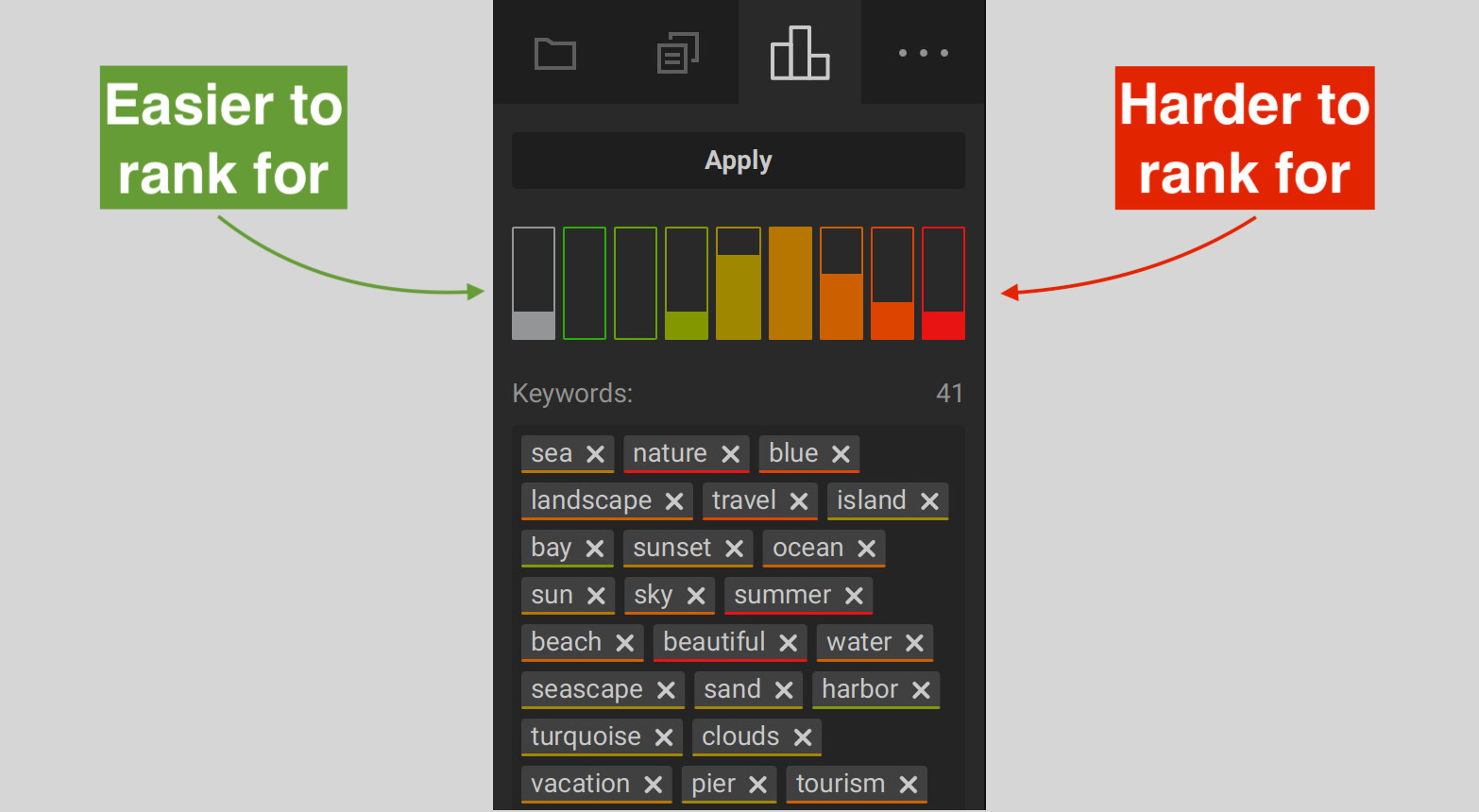
Keyword Competitiveness in Xpiks
Should you want to turn to more professional tools than the agency search bar, in Xpiks, for example, you can find some data on keywords competitiveness. But never once auto-keywording (or even good old keywords suggestions) itself was advertised as a “set and forget”, it was always treated as a starting point.
What to do now
Stop treating diversification as a file-transfer exercise. Start treating it as a targeted content strategy. Find a hard-to-reach niche, keyword it manually for specific commercial intent, and then distribute it widely. That is how you survive the shift from content to data.
But don’t just run now to search which drone should you order. Usually you already have access to some pretty unique things, you just forgot about it. Think about it first - there might be good opportunities “hidden” in the plain sight.