
Even before the AI, microstocks were “saturated” for good 10 years already. Which is to say, competition was substantial and it was hard to stand out for quite some time. The situation has already been quite discouraging for many - so much so that microstocks were downgraded from primary income source to a “hobby” level. And then, enter AI - part a flood of low(ish) quality assets from the new wave of contributors that diluted search results, part - a distraction for lowest-paying customers (still taking away their money). Dire situation, no doubt. But still, some of the contributors are striving! But how? What is it that they do differently? In this blogpost we will try to answer this.
Competition is hard

First page of Shutterstock search results can say a lot about the content produced
Competing in microstocks for a search query of a customer is hard. Essentially, to not even to win a sale, but to get in front of the customer, you have one of these options:
- “Celebrity”. Customer has to know you directly by style or by name (your portfolio has be “well-known”. It is possible, but extremely rare)
- Best-seller. You have to rank high in search results (unlikely, but possible if you’re the “best-seller” already in that search query)
- Volume. You have to have multiple artworks that rank for that search query (easier, but a lot of hard to work and luck to make them all rank) that overtake competitors by sheer amount of artworks. Can be replicated easily, but unlikely many try this. By volume, you have to think more in the direction of size of Wirestock portfolio, than just “10 times larger than you have” right now.
- Luck. Of course, many successful people (usually those, who don’t sell you some kind of attempt to justify their “highly agentic” strategy in a course or e-book) always know how much luck was involved in their success. Bad news for you - not much you can do here.
Then, after you got in front of the customer, chances they buy your assets depends on what they have in mind and how much your asset works for their current project. This is somewhat offset by the sheer number of buyers and the fact that now they mostly use unlimited subscriptions (so buying more is “painless”). So we will be mainly covering the getting “in front” part of the equation.
AI eats the long tail of lowest-paying customers
AI is your direct competitor in terms of assets only if you were producing low quality or uncomplicated assets of high demand (those were more used for training of it) - like “blue backgrounds”.
Otherwise, not as a direct competitor, AI just makes your usual life much harder:
- customers that don’t have much budget (and, consequentially, don’t work for companies that don’t care about the media they produce), will switch to AI-generated assets. Good news for you that they likely haven’t been your main customers either way.
- on agencies that do accept AI-generated content, search results of customer queries are now diluted by AI-generated assets. Agencies show them by default and customer has to do an explicit action to disable them in search output (small, but non-zero friction).
Which is to say, AI is not your main problem at these times. At least not yet and at least it was not the problem before, when the situation was already tricky.
just for now, you can assume that “better” customers still care about your art
You should understand that larger customers of microstocks that produce “better” media (if such thing even exists), would not opt to just buy AI-generated art instead of higher-quality human-made, because they have some quality bar for it. So it’s only the lowest-paying customers which fall off.
Contributors try hard to come up with strategies
Producing more assets
Fighting fire with fire, you might think, will land you more views (and hopefully more “clicks”) from the customers. Just if you had a tad more (thousands) assets in your portfolio - it would finally cut it. But distributing generic content across more platforms just makes you invisible in more places. There’re things that volume itself cannot fix, or at least the amount of volume you think about (the real volume that can make a difference can be 100-1,000 times larger than you have in mind).
Resurrection of Editorial
First (smart) thing that everyone came up with was to bring back Editorial content. The logic is that even though AI stopped adding an extra finger to humans (just note: contributors still think AI is the largest evil here), it cannot depict actual people and places precisely, so if you do it instead, you have some kind of a moat.
Resurrection of Exclusivity
Exclusivity, which was always a questionable choice at best (in the end, the whole purpose of agencies was that you sell everywhere at once), is now also attempted as a means of increasing earnings (usually for some special niche agencies).
Smart distribution of assets
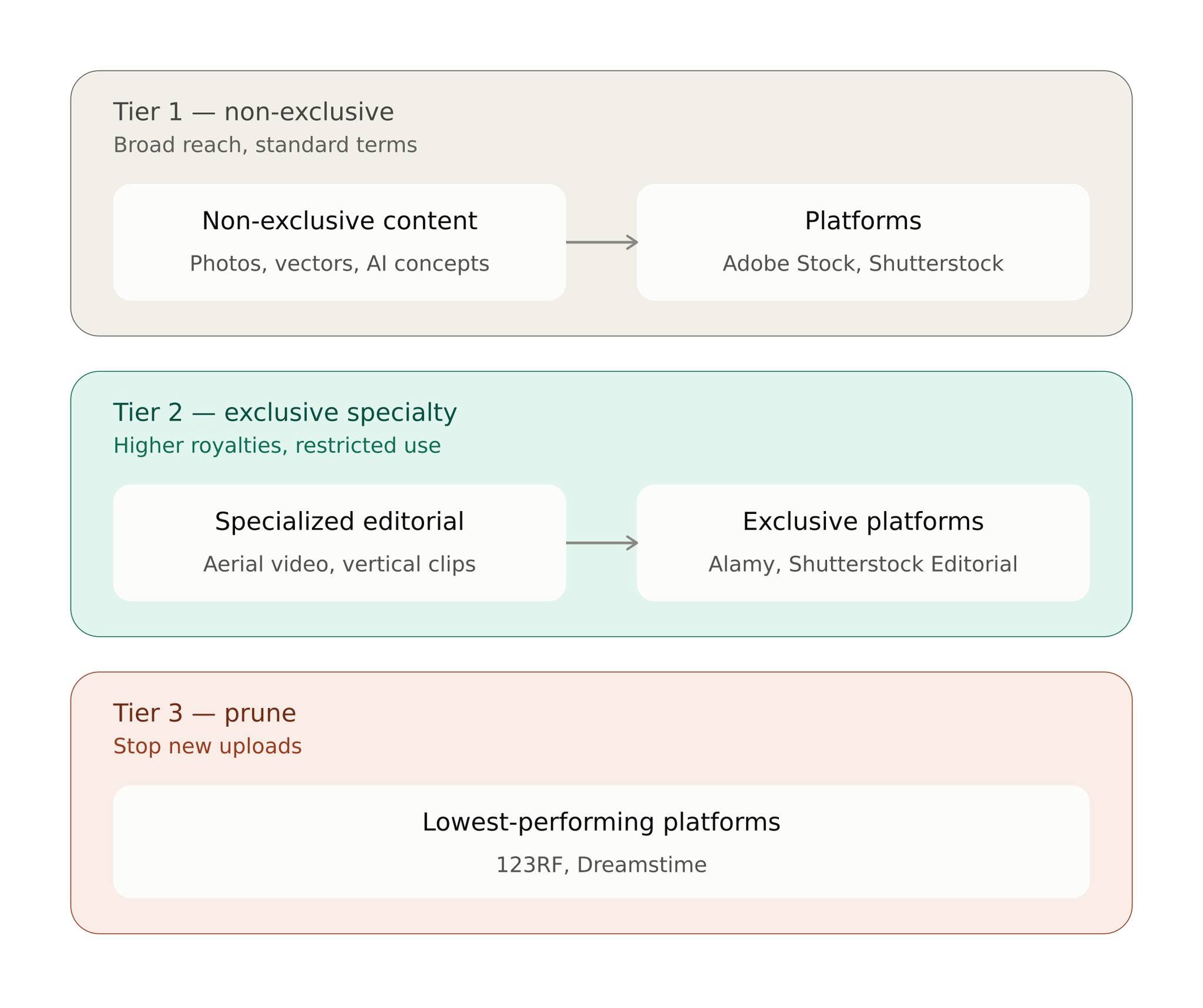
Made more popular by Alex Rotenberg, the following idea of what to do with your assets:
- Tier 1 (Core Volume Engine): Mirror all non-exclusive commercial photography, standard vectors, and AI-assisted concepts across Adobe Stock and Shutterstock. This maintains download velocity and secures annual AI dataset payouts.
- Tier 2 (High-RPS & Editorial Specialists): Upload specialized 4K aerial video and native vertical clips directly to Pond5. Send all local news, event, and real-world documentary editorial assets to Alamy and Shutterstock Editorial to benefit from fast review queues and higher per-sale payouts.
- Tier 3 (Pruning Strategy): Stop uploading to legacy low-performing agencies (123RF, Dreamstime) where review queues exceed reasonable limits and sales are negligible.
Which is really the way smarter rehashing of other ideas, but even that is not addressing the actual issue.
The core problem no strategy is addressing
While most of these strategies make some sense, in my opinion, they are all directed towards how to most optimally fight the competition that has already happened. While the best strategy should get one step before that and at least try to not to compete at all.
The link above is to the “Blue Ocean Strategy” book wiki page - and even if you are not going to read the book, read the Wiki page and think about it for a bit. For me the best summary of it can be the reverse of Dostoevsky opening of Anna Karenina:
All failed microstock contributors are alike; every successful one is successful in its own way
The mentioned Wiki page argues that what correlates with success of most companies is that they found a part of the market with less to no competition and strived there. Think about it from the point of view of microstocks - if you compete in a certain category, to get noticed you’ve got to be better than 95% of everyone else (the “red ocean strategy” from the book). If you don’t compete there, for your (potentially small) niche you just gotta be there at all.
It does not mean that you can find such a niche where there’s literally no one. But you can find a small enough niche where no one is producing assets in your style, with your creative vision, with your insight. No one can compete with you at being you, because some things will come naturally to you, the problem is just to double-down on that uniqueness long enough.
Drafting the strategy
The best strategy that will work for you is unique to you. We can think about which attributes it has, but you need to understand that there’s no cookie-cutter way to succeed (there was such a way 20 years ago when microstocks gained traction, but not anymore).
What the strategy is NOT
In as much as to define what attributes the strategy can have, it is equally important to say that it can NOT have.
Copying what successful ones do

Previously in this blog we discussed High-barrier niches. It was very well received by the community and as much merit as it has, I’d like to specifically point out here that all the things it mentioned:
- astrophotography
- macro
- underwater photography
- drones
- other hard-to-get niches
are not The Answer. Anything, that looks like a shortcut, is not. It is a tactic you can choose in the end if you know why, but it is certainly not a strategy on it’s own, so don’t just copy it blindly. It is just something that worked for other contributors. Bad news are that those exact subniches are already taken - you are late. Good news is that there’re more available.
Doing what you already do, but better
This is just not candid. If you think the problem was in your execution, it likely wasn’t (it can be in some cases, but highly unlikely). Just doing what you did for the last 5 years will not cut it anymore.
Not unique enough
If someone else can start doing today exactly what you chose to do and they will achieve exactly the same level of success (whatever that was), it was not a (good) strategy. Remember that strategy has to be uniquely tailored to you in such way that others likely will have troubles implementing it. It can be anything: skills, props, people, locations - some “unfair advantage”, however temporary, you have access to that others won’t.
What the strategy can be
To form a strategy you have to think about the customer first. Specifically about what content the customer you chose might need and what for. And you need to go really narrow (don’t worry about it - read about extremely narrow focus in one great business blog), like very specific. It does not mean all of your customers will be like that, but it will greatly help with choosing the content.
Narrow enough
Form a hypothesis and try to do a small “proof of concept” content for it. By way of example Hugo Kurk is shooting drone video of certain types of European infrastructure: power plants, urban development, industry etc. Not so much of everything else you can do with a drone, but just this topic (and I’d still say it is quite broad!). It is editorial enough (can be a specific power plant, specific city and country), drone video (hard-to-get niche, you’ve got to have a drone at the very least, also video which is another category on it’s own) and it is in demand (we live in times where environmental issues just never stop). All this is easy to say now, when his success is obvious, but you can track back his decisions in YouTube channel.
Who potentially can the customer of such content be:
- environmental social media influences
- building companies
- Central-European governments
- Right-wing European news media
Don’t worry that if you define customer very narrow, others will not buy your content. Just defining it very narrow helps you to answer The Question: “what content exactly such a customer might want to buy?”.
Just think about it: each of these groups care about different angles and you cannot satisfy all of them at once. You will have great success if you will satisfy just one group better than others. And other groups will partially also buy from you because we all buy things based on some set of trade-offs (read the article linked above).

Other simple examples, from microstock illustrators: a 1980s “comic books” cartoonish style is certainly not everyones cup of tea and that is what makes it amazing. Certainly not everyone who buys illustrations for their blog or marketing materials would even opt for this! This is a narrow enough scope that has a chance to succeed. A very broad one doesn’t.
Aligned with your strengths
Great strategy has to be easy(ish) for you to execute. It has to overlap with your talents (or aspirations) and strengths. There’s no point to test or adopt a strategy that you won’t be able to execute. If you are not good at shooting people, there’s no need to focus on a subniche that involves models, however lucrative it may seem.
If you don’t know what those strengths of yours are (introspection is hard for a reason!), ask your friends or relatives. Chances are they will say what comes easy to you and not to them.
Slightly forward-looking
The best time to plant a tree is one hundred years ago. The second-best time to plant a tree is today.
In as much as it is hard to do, you’ve got to think about things that are either evergreen or will be “green” for quite some time. For example, today there’s not much point to do COVID vaccine shots anymore, even though they were a cash cow for a short period of time.
The trick is to think not about specific things, but about tensions and topics. For example, what is current on Earth, your continent, country, culture, work industry, identity now, that with high chance will make sense also 5 years from now?
Environmentalism, immigration in Europe, US-China tensions are some easy choices that everyone can think of. What is everyone missing that you know? It may come from your unique knowledge from your job, social status, history etc. It does not have to be epic level insights.
Reactivity means you are loosing by default
Have you played video games? When you are staying Re-active - reacting to the events in the game that have already happened - you are always in the mode of “extinguishing the fires”, never have time to build-up your plan. On the other hand, when you are Pro-active, you are executing some strategy of yours, sometimes even despite the events in the game that can make you loose, but this is the only way you can win.
If you’re making content all day every day and it does not work, stop. Ask yourself hard questions and start thinking about customers first, where you can specialize to the absurd level and think about long-term reasons why you’re creating this or that content.
Microstocks really do not work until they do. Finding that place became really hard nowadays, but successful microstockers are a proof that it is still possible.