WARNING: This is NOT a legal advice. AI field changes at a crazy speed nowadays so things might become outdated even before I publish this blogpost. Double check all terms by using the provided links before relying on them.
Perhaps without surprise, most Paid commercial services grant you full ownership of the images you create, making them legally suitable for resale, provided the input prompt itself doesn’t violate any copyrights.
Most Free Tiers of these same services either do not grant you ownership or apply a Creative Commons license that restricts commercial use, making them unsuitable for this purpose. There’re some exceptions though (see details below).
Open-source models run locally give you the most freedom, as their licenses typically do not claim any rights to the output, leaving you as the creator and owner.
NOTE 1: There’re so many absolutely random image generators that are wrappers over other services or open-source models, that it’s not physically possible to include them all.
NOTE 2: Author of the blogpost does not personally endorse any particular service or selling AI-generated images on microstocks to begin with. This is for informational purposes only.
OpenAI DALL·E (ChatGPT image generation)
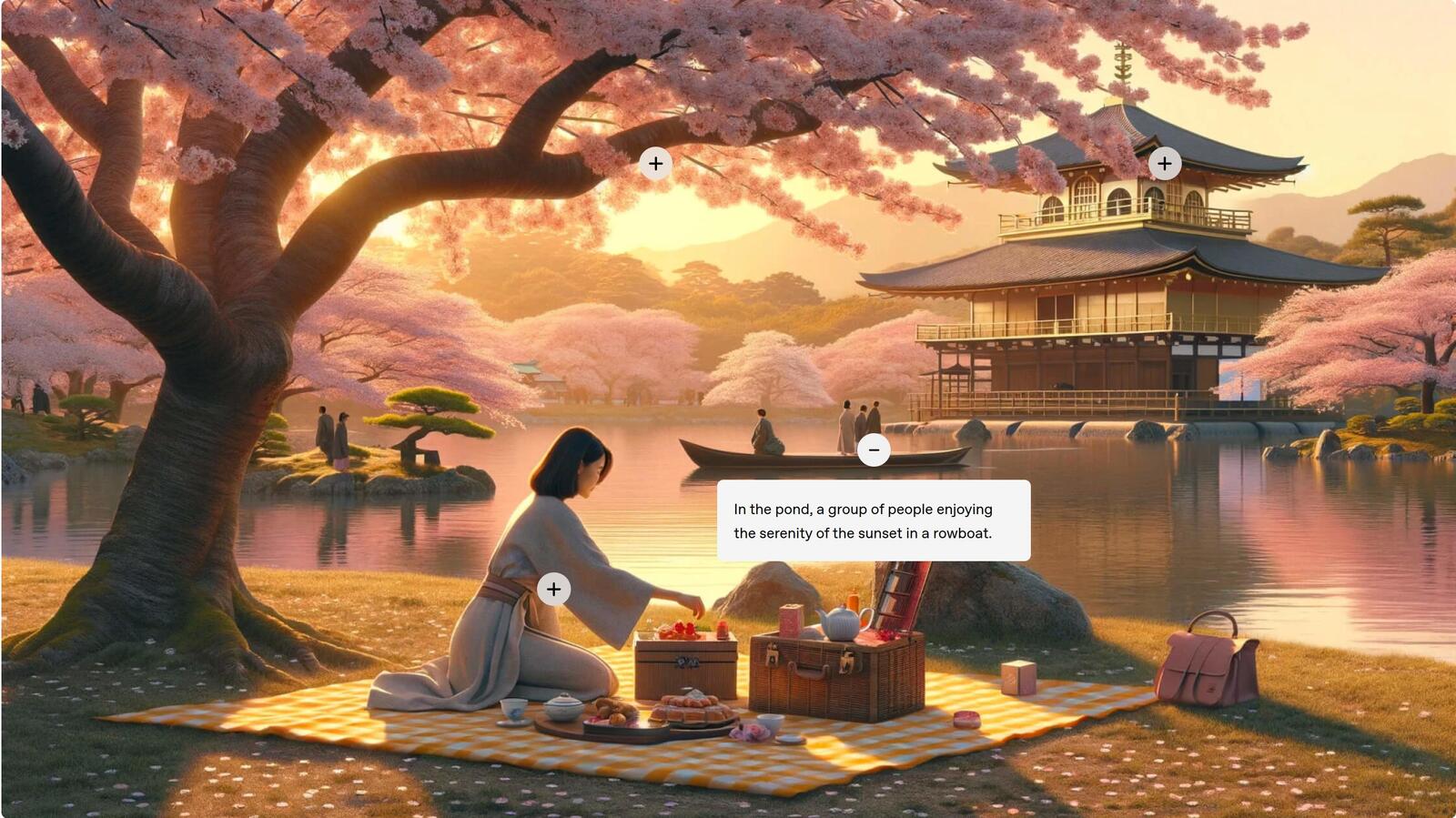
OpenAI’s current Terms of Use make it clear that users own the images they create (“Output”) with DALL·E/ChatGPT.
Ownership of content. As between you and OpenAI, and to the extent permitted by applicable law, you (a) retain your ownership rights in Input and (b) own the Output. We hereby assign to you all our right, title, and interest, if any, in and to Output.
In fact, OpenAI assigns “all [its] right, title, and interest” in generated images to the user. There is no clause forbidding commercial exploitation: subject to complying with OpenAI’s content policy, you may use and sell DALL·E outputs freely. In practice, OpenAI explicitly states you have “the rights to reprint, sell, and merchandise” images you create with DALL·E (so long as you follow content guidelines). In short, OpenAI’s terms grant full ownership and thus allow selling DALL·E - generated images on stock sites (again, content-policy compliant use only).
Midjourney
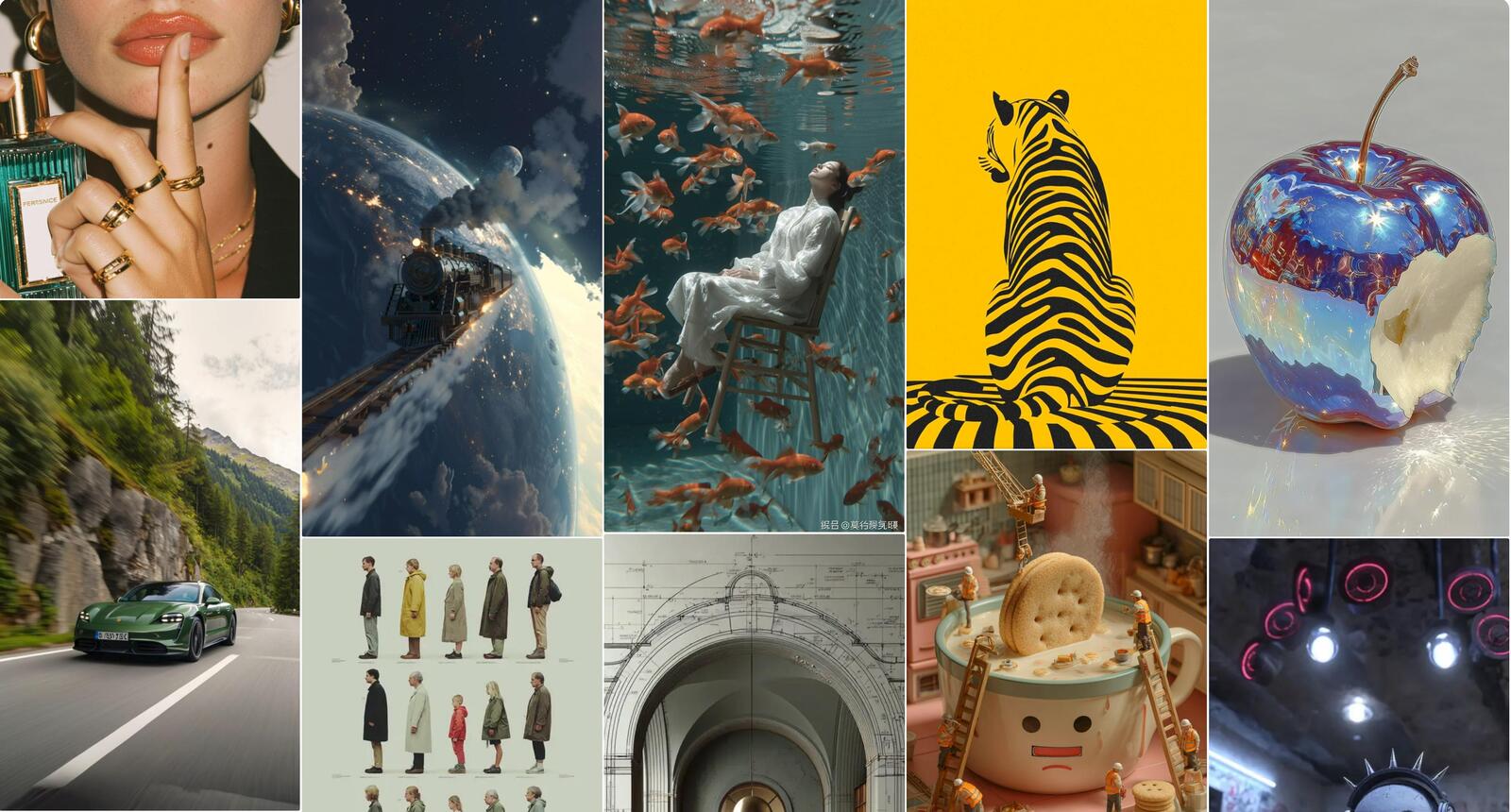
Midjourney’s Terms of Service (effective June 2025) similarly grant users full ownership of the images they generate. The TOS explicitly say that “You own all Assets You create with the Services to the fullest extent possible under applicable law”.
You own all Assets You create with the Services to the fullest extent possible under applicable law. There are some exceptions:
- Your ownership is subject to any obligations imposed by this Agreement and the rights of any third-parties.
- If you are a company or any employee of a company with more than $1,000,000 USD a year in revenue, you must be subscribed to a “Pro” or “Mega” plan to own Your Assets.
- If you upscale the images of others, these images remain owned by the original creators.
There are limited exceptions (for example, very large companies must use certain paid tiers), but for individuals on a paid plan, Midjourney does not claim copyright to your creations. In effect, users may do anything with their Midjourney images, including commercial use. Users on paid subscriptions hold all rights to their output, so selling those images (e.g. on microstock sites) is allowed by Midjourney’s terms. The only caution is that free trial/demonstration users historically had a non-commercial license, but under current rules active paid subscribers own the images outright.
Stability AI (DreamStudio and Stable Diffusion models)
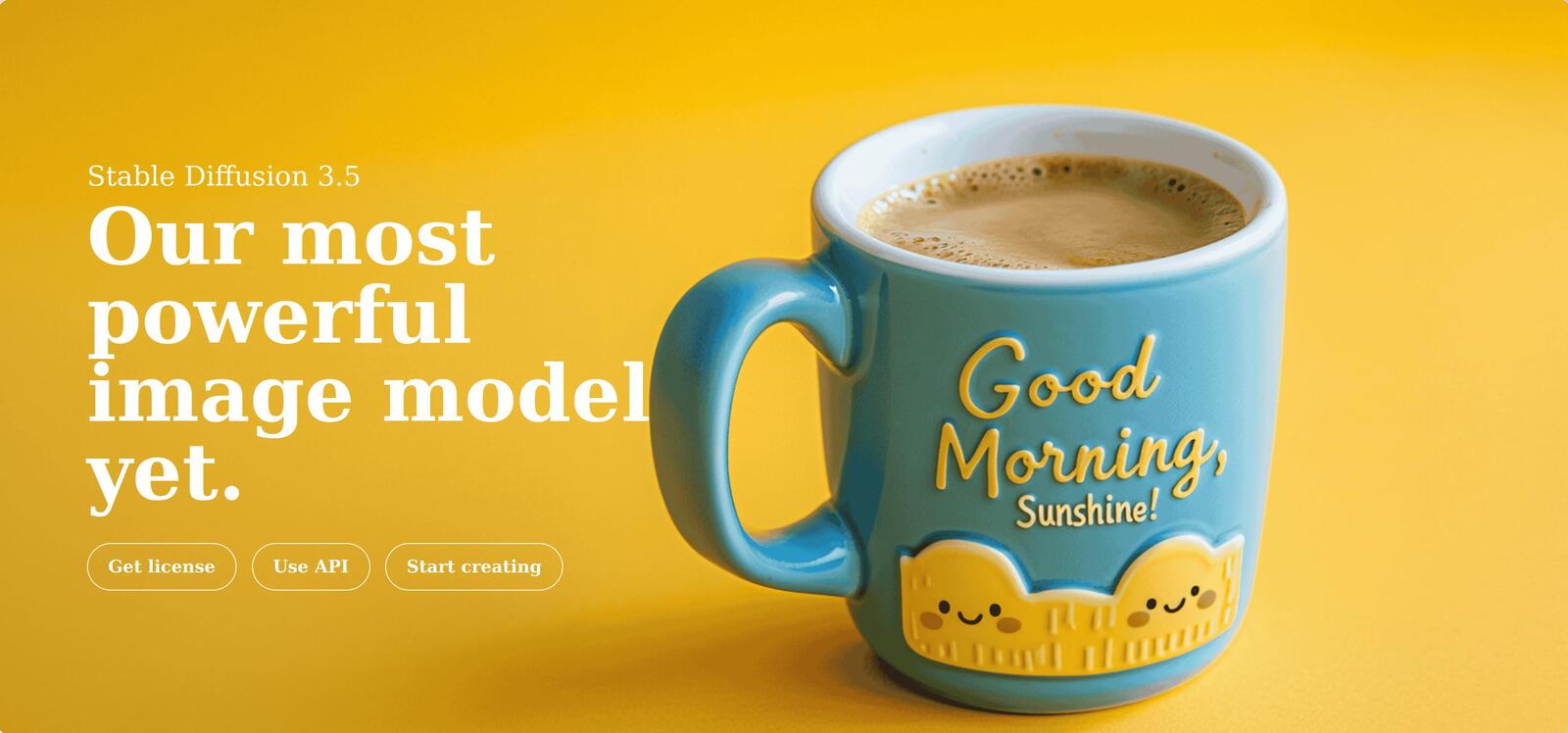
Stability AI’s platforms use the open Stable Diffusion models. In DreamStudio’s Terms of Service (Stability’s official hosted service), Stability likewise assigns ownership of generated images to the user. The DreamStudio TOS state:
As between you and Stability, you own the Content that you generate using the Services to the extent permitted by applicable law.
In other words, Stability does not retain copyright in your DreamStudio creations. Thus, commercial exploitation (e.g. selling the images) is permitted by those terms. Note that all use of DreamStudio is also subject to the underlying model license (the CreativeML Open RAIL-M license), but in practice this license still allows commercial use (see below).
Importantly, the underlying Stable Diffusion (open-source) models carry licenses that explicitly permit commercial use. Stability AI’s Community License (RAIL) for Stable Diffusion says it is intended to allow “research, non-commercial, and limited commercial uses” of the models free of charge.
This Agreement is intended to allow research, non-commercial, and limited commercial uses of the Models free of charge. In order to ensure that certain limited commercial uses of the Models continue to be allowed, this Agreement preserves free access to the Models for people or organizations generating annual revenue of less than US $1,000,000 (or local currency equivalent).
In fact, Stability grants a worldwide, royalty-free license to use, reproduce, distribute and modify the models for any Commercial Purpose, provided you register and remain under their $1M revenue cap. In plain terms, if you run Stable Diffusion yourself (locally or via HuggingFace/Ollama/OpenRouter), you may commercially use the outputs (and sell images) so long as you comply with the license conditions. For almost all individual creators, this is effectively unrestricted.
Adobe Firefly (Adobe Generative AI)
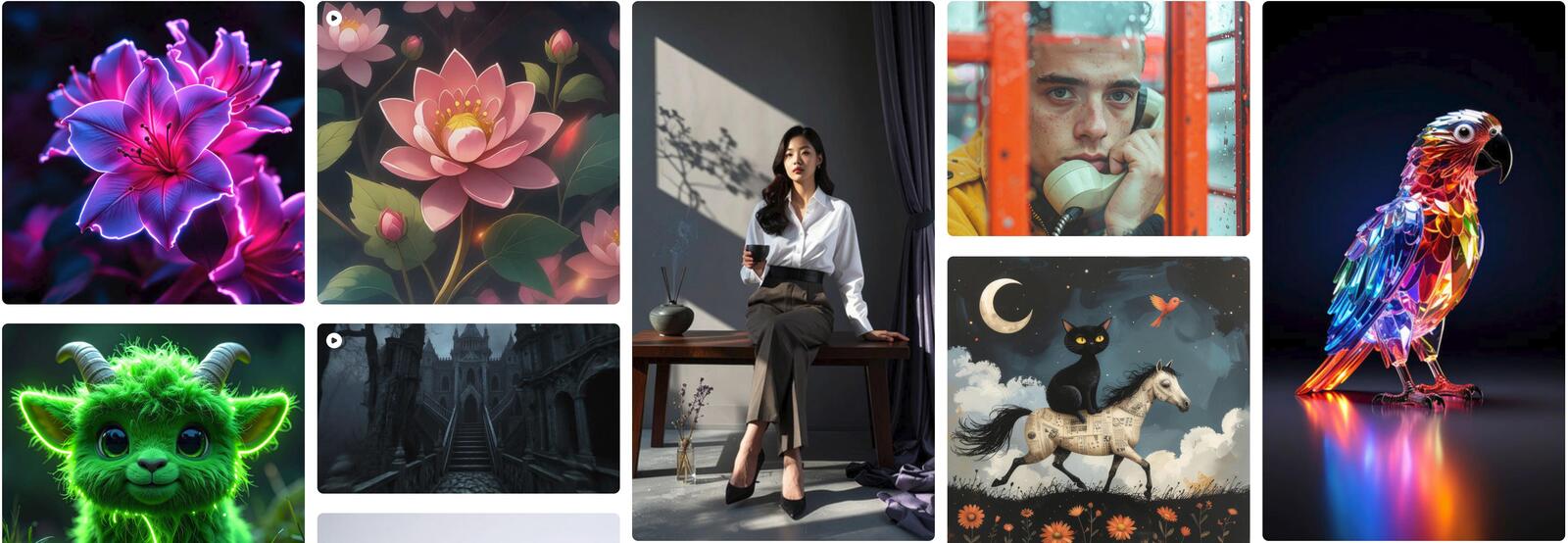
Yes, you kind of can use Adobe model to sell on… Adobe Stock.
Adobe’s generative-AI tools (branded Firefly) are designed for commercial usage. Adobe’s official Generative AI User Guidelines explicitly state:
In general, you may use outputs from generative AI features in commercial projects. However, if Adobe designates in the product or elsewhere that a beta version of a generative AI feature cannot be used commercially, then the generated outputs from that beta feature are for personal use only and cannot be used commercially.
In practice, Firefly’s content is trained on commercially licensed material, and Adobe grants users rights to the images. Adobe’s terms do not claim ownership of your creations; instead, you own your outputs and can use them for any purpose, including selling. Thus Firefly images may be sold back on Adobe Stock site (thus, “closing the loop”) and also others, in accordance with Adobe’s terms (again noting that agencies have their own acceptance policies, but from Adobe’s side the images are yours for any use).
Google Gemini (Nano Banana / Gemini 2.5 Flash Image)
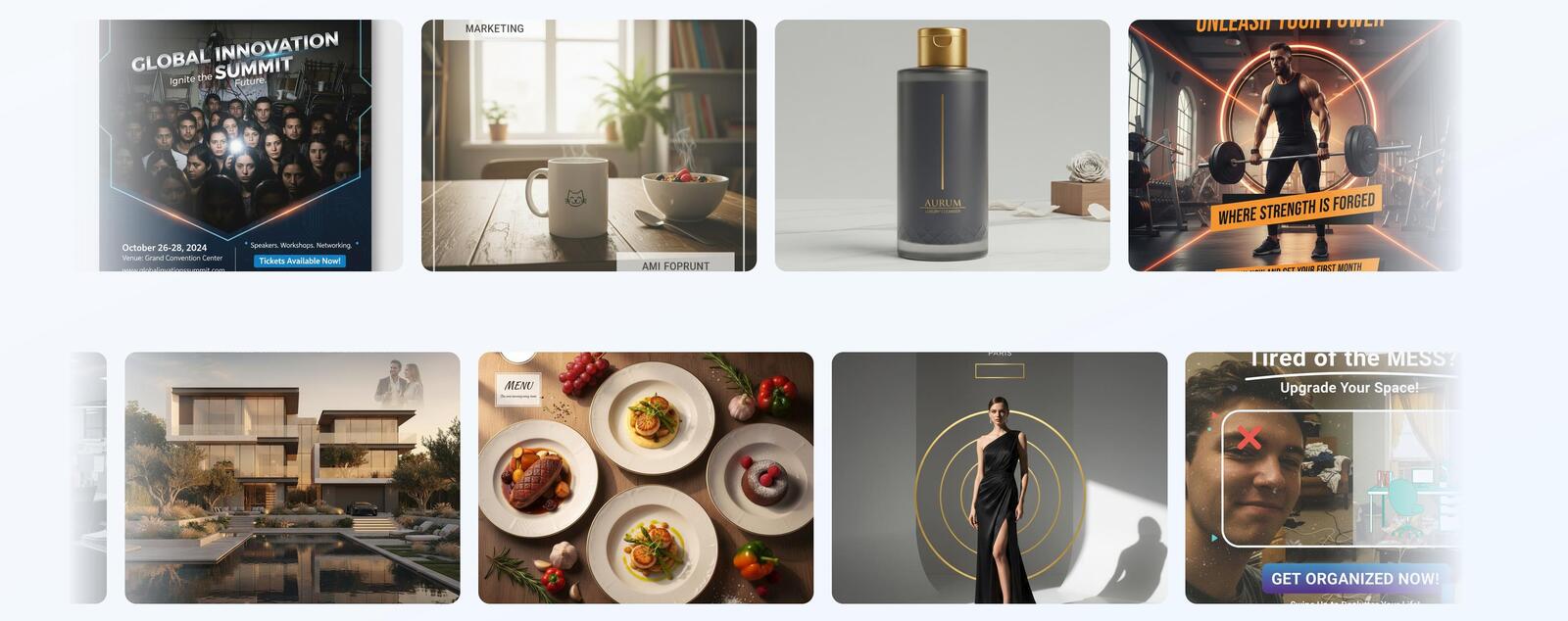
Gemini 2.5 Flash Image aka 'Nano Banana'
Gemini’s terms do not claim ownership of generated images, so the terms allow you to commercially use / sell images you create with Nano Banana — with a few practical caveats, one of which is the watermark…
Some of our Services allow you to generate original content. Google won’t claim ownership over that content. You acknowledge that Google may generate the same or similar content for others and that we reserve all rights to do so.
The Additional Terms explicitly say you must comply with applicable law and that “You’re responsible for your use of generated content, and for the use of that content by anyone you share it with.”.
For Unpaid Services (e.g., free AI Studio usage / unpaid API quota) Google may use prompts and outputs to improve models; for Paid Services Google says it does not use your prompts/responses to improve their products (they limit logging to safety/abuse detection). This affects whether your inputs/outputs might be used in training, but it does not change ownership.
Google states that all images created or edited with Gemini 2.5 Flash Image (Nano Banana) will include an invisible SynthID digital watermark (and visible watermark in some app contexts). That is a product detail (not an ownership restriction), but it may be relevant for downstream use or platform disclosure.
Leonardo AI
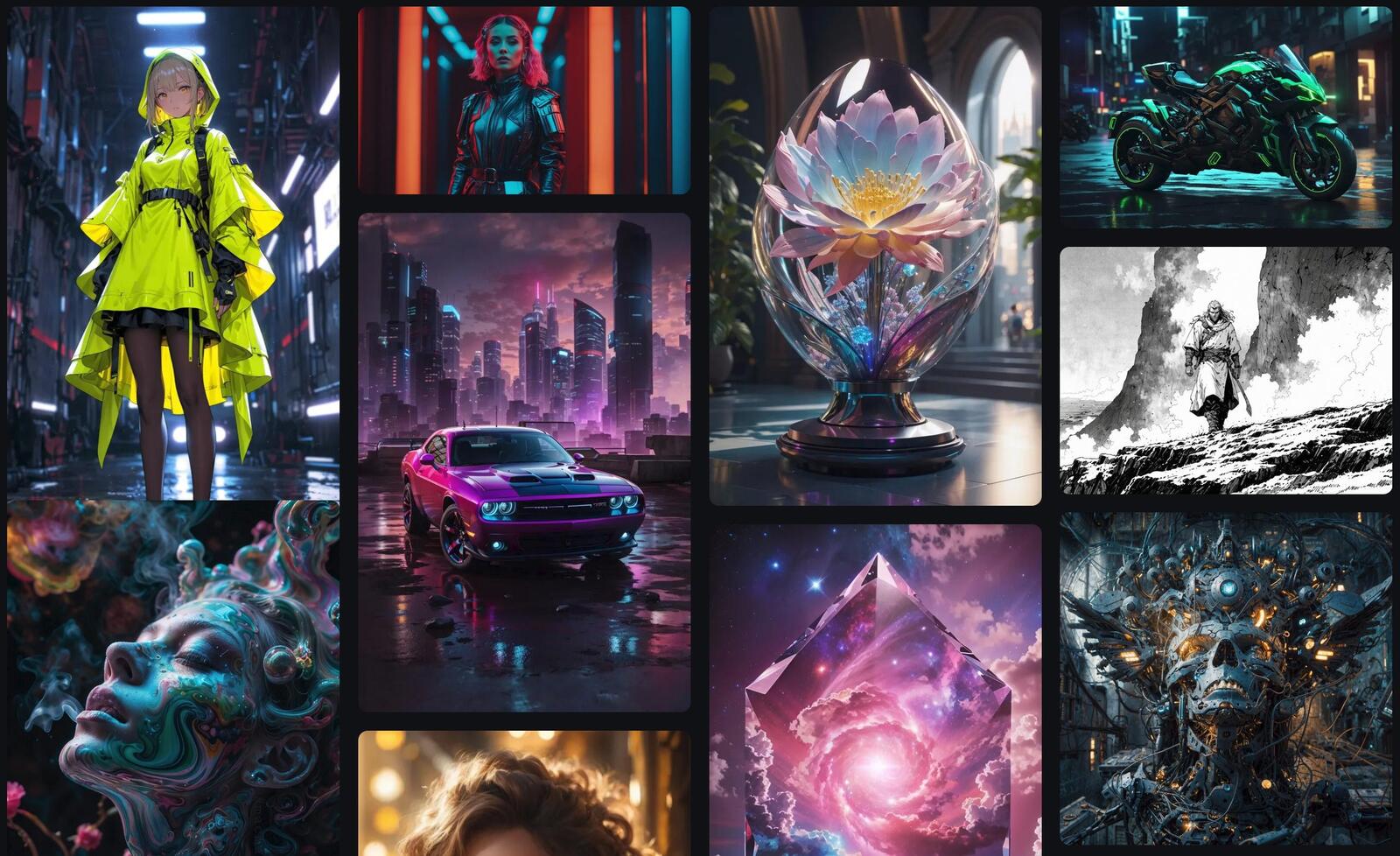
Similar to Midjourney, Leonardo.AI operates on a tiered model. Free users’ creations are public and licensed under a Creative Commons (CC BY-NC-SA 4.0) license, making them unsuitable for commercial resale. Paid subscribers gain full ownership and commercial rights (expressed in a horrific legal lingo in their terms).
If you are on one of our paid Subscriptions (Paid Subscriber), as between the Parties, subject to your compliance with these Terms, ownership of all Intellectual Property Rights in any Content you, or your Authorized Users, create while using the Platform will vest in you upon creation, and to the extent that ownership of such Intellectual Property Rights does not automatically vest in you, we hereby assign all such Intellectual Property Rights to you and agree to do all other things necessary to assure your title in such rights.
So to rehash, the free “Basic Plan” does not grant commercial rights. The paid “Plus Plan” explicitly grants you ownership and the right to use the images for commercial purposes, including selling on microstocks.
Microsoft Image Creator (Bing Designer)
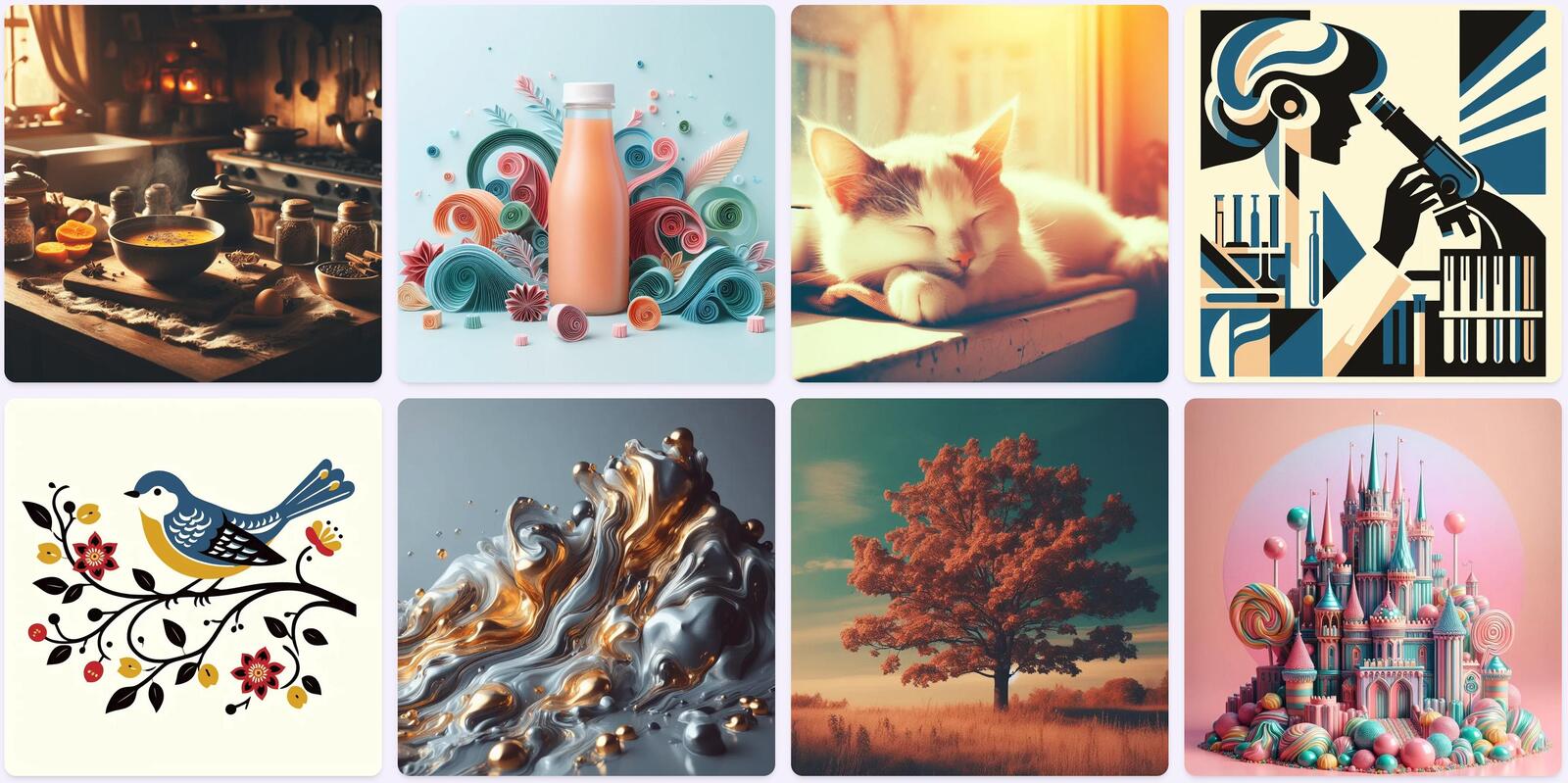
Microsoft Image Creator examples
In short, under the present terms you may use and sell images made with Bing’s AI image generator.
Microsoft does not claim ownership of Prompts, Creations, customizations, instructions, or any other content you provide, post, input, or submit to, or receive from, the Online Services (including feedback and suggestions).
Microsoft’s AI image tool (the “Image Creator” in Designer/Bing) had an earlier rule limiting images to non-commercial use, but this has changed in late 2023. The current Terms of Use no longer contain an explicit “personal use only” clause. Official Microsoft Q&A notes that the updated terms removed the non-commercial ban and that the Image Creator can now be used more freely. Indeed, Microsoft’s FAQ now suggests that “you can further edit your generated images and turn them into designs like digital cards, posters, [etc.]” - implying commercial projects are allowed.
RunwayML
Runway’s policies make ownership clear. Their FAQ says:
the content you create using Runway is yours to use without any non-commercial restrictions from us. As between you and Runway, you retain ownership and all your rights to content you upload and generate on Runway.
This includes, but is not limited to, monetized or non-monetized YouTube uploads, other short-form video uploads (e.g. Instagram Reels, TikTok), social media posts, film festival entries, product advertising, and anything else that may require commercial use rights.
Open-Source AI Models
For open-source models you run yourself or access via tools (Hugging Face, Ollama, OpenRouter, etc.), the model license governs usage. Popular text-to-image models (Stable Diffusion 1.x/2.x/3.x, SDXL, etc.) generally use the CreativeML Open RAIL license from Stability AI. As noted above, these licenses explicitly permit commercial use of model outputs. In practice, this means if you run Stable Diffusion locally (or via a third-party host), you own and can sell the images you create (again, assuming any input content you provided was legal).
Hugging Face models
NOTE: Hugging Face is a hub for models (e.g. like GitHub is for software engineering), it only hosts image generation models made by others
Models on the Hugging Face Hub are individually licensed. Many use permissive licenses (Apache 2.0, MIT), which allow commercial use, modification, and redistribution—always verify each model’s specific license page before deployment. Here’s a good overview.
To find models on Hugging Face, you can use their search.
Ollama
NOTE: Again, Ollama is a tool for running local (and remote) models, it’s not a model provider itself
Ollama distributes open-source LLMs under the MIT license, which allows free commercial use. There are no additional fees or revenue restrictions for using models via Ollama in a company setting.
OpenRouter
NOTE: Open Router is a website that allows you to call other providers interchangeably.
OpenRouter aggregates third-party models; its own TOS govern platform usage but do not claim ownership of generated content. Commercial rights derive from the underlying model’s license, and usage fees may apply per model.
Selling AI-generated images on microstocks
For full details on selling, check out the main blogpost on generative AI.
Who is selling AI-generated artworks
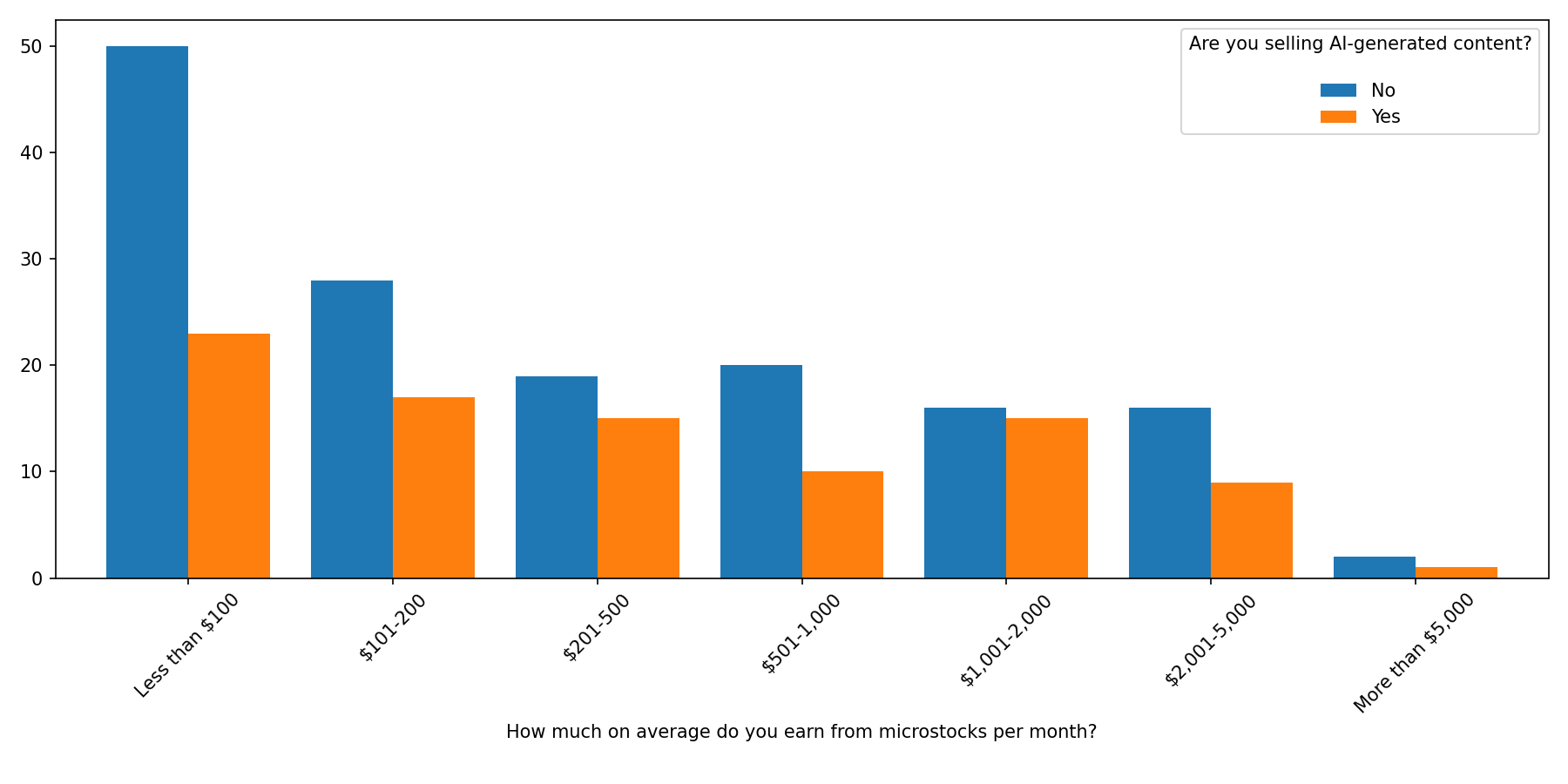
Contributors of all earnings tiers are actually selling AI-content, accordingly to our 2024 microstock survey. The only exception are lower-earning tiers that sell less of AI-content than their higher-earning peers.
Agencies that accept AI-generated content
Agencies here split into 2 camps: some are banning AI-generated content (obviously while generating it themselves) and others accept it. Let’s look briefly at the most prominent ones:
| Agency | Accepts AI content | Has AI generator |
|---|---|---|
| Shutterstock | No (policy) | Yes |
| Adobe Stock | Yes (policy) | Yes |
| Getty Images | No | Yes |
| Pond5 | No (policy) | No (but Shutterstock has) |
| Depositphotos | No (policy) | No |
| Dreamstime | Yes (announcement) | No |
| Alamy | No (announcement) | No |
| Creative Market | Yes (sort of) | No |
| 123rf | Yes (announcement) | No |
| Canva | No | Yes (sort of) |
| Vecteezy | Yes (policy) | No |
| Panthermedia | Yes (announcement) | No |
Uploading and keywording AI-generated content
For agencies that do accept such content, usual requirements are adding AI, generative and generative AI keywords and when uploading, assigning a correct category (like Illustration instead of Photo) and marking that this is AI content with a checkbox. You can read more here.
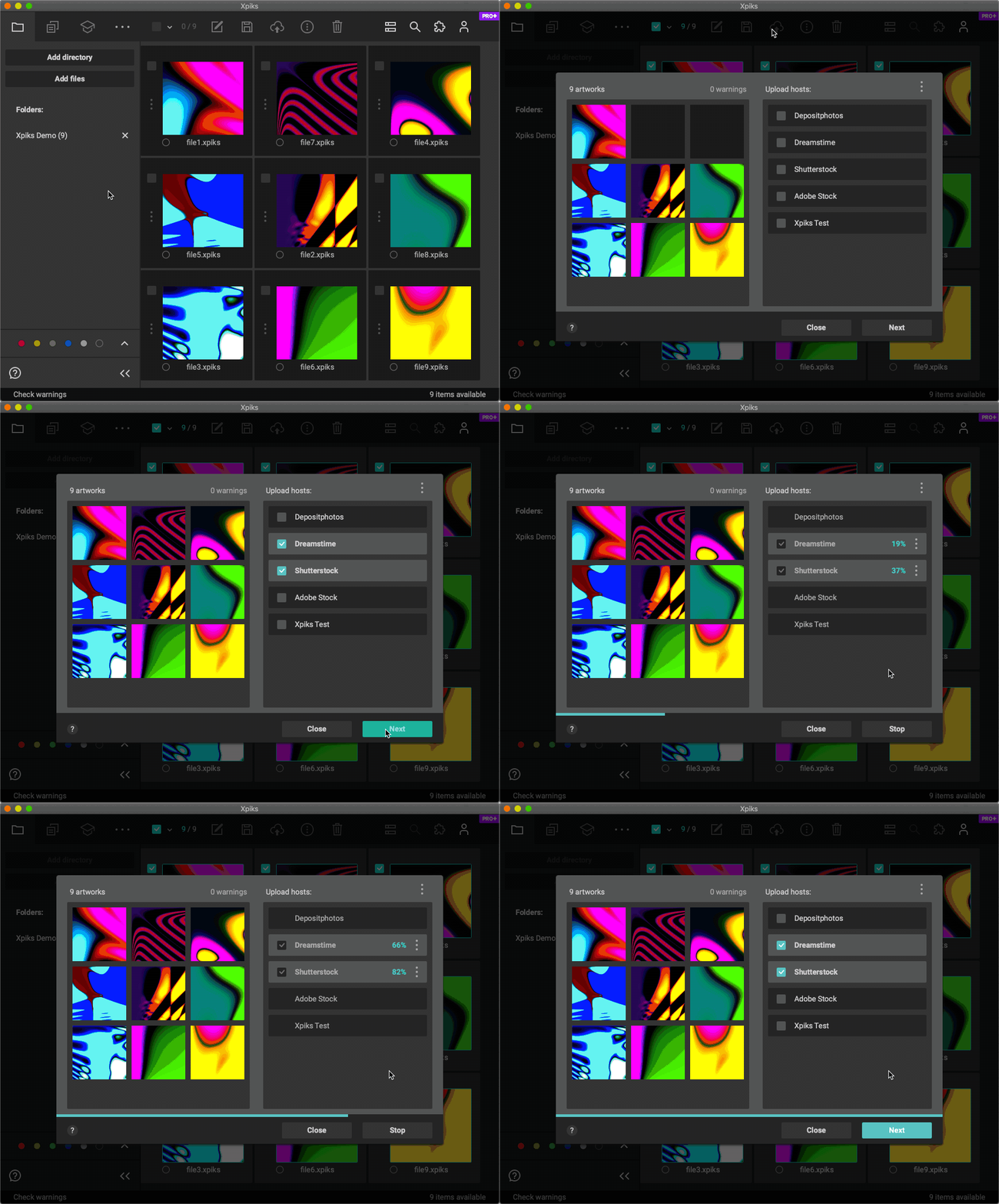
In Xpiks, uploading is as easy as selecting files and pressing “Upload” button. In the end, AI-generated files are still usual files.