Shutterstock is a top-tier agency, if we judge by how complicated the royalties structure they have. More seriously though, contributors still rank it in the top-3 of the most popular agencies, as of late 2024. Even though contributor earnings vary significantly on Shutterstock, to put this politically correctly, it can be really hard to understand how they actually work. So hopefully it will be clearer once you finish reading.
Basic idea
At its core, in case you didn’t know, the compensation model for Shutterstock contributors operates on a principle of revenue sharing. Each time a customer licenses a contributor’s work, the contributor earns a percentage of the price paid for that license. But the percentage itself depends on a few factors. Quite a few factors, in fact.
These include the specific type of subscription plan the customer has chosen, the kind of license associated with that plan (such as Standard or Enhanced), and the contributor’s current earnings level at the time the download occurs. This is before I mention that earnings level is also different for different kinds of content (e.g. images/video). To make matters worse (for contributors), Shutterstock resets contributor earnings level on January 1st every year.
Royalty levels
As we have already discussed, Shutterstock has a system of distinct earnings levels for contributors who upload images, illustrations, and vectors. These levels are determined by the total number of licenses sold for their image-based content within a given calendar year. It is important to note that a contributor’s progression through the earnings levels for images and videos is independent. This means that a contributor’s download count and level for images do not influence their level for videos, and vice versa.
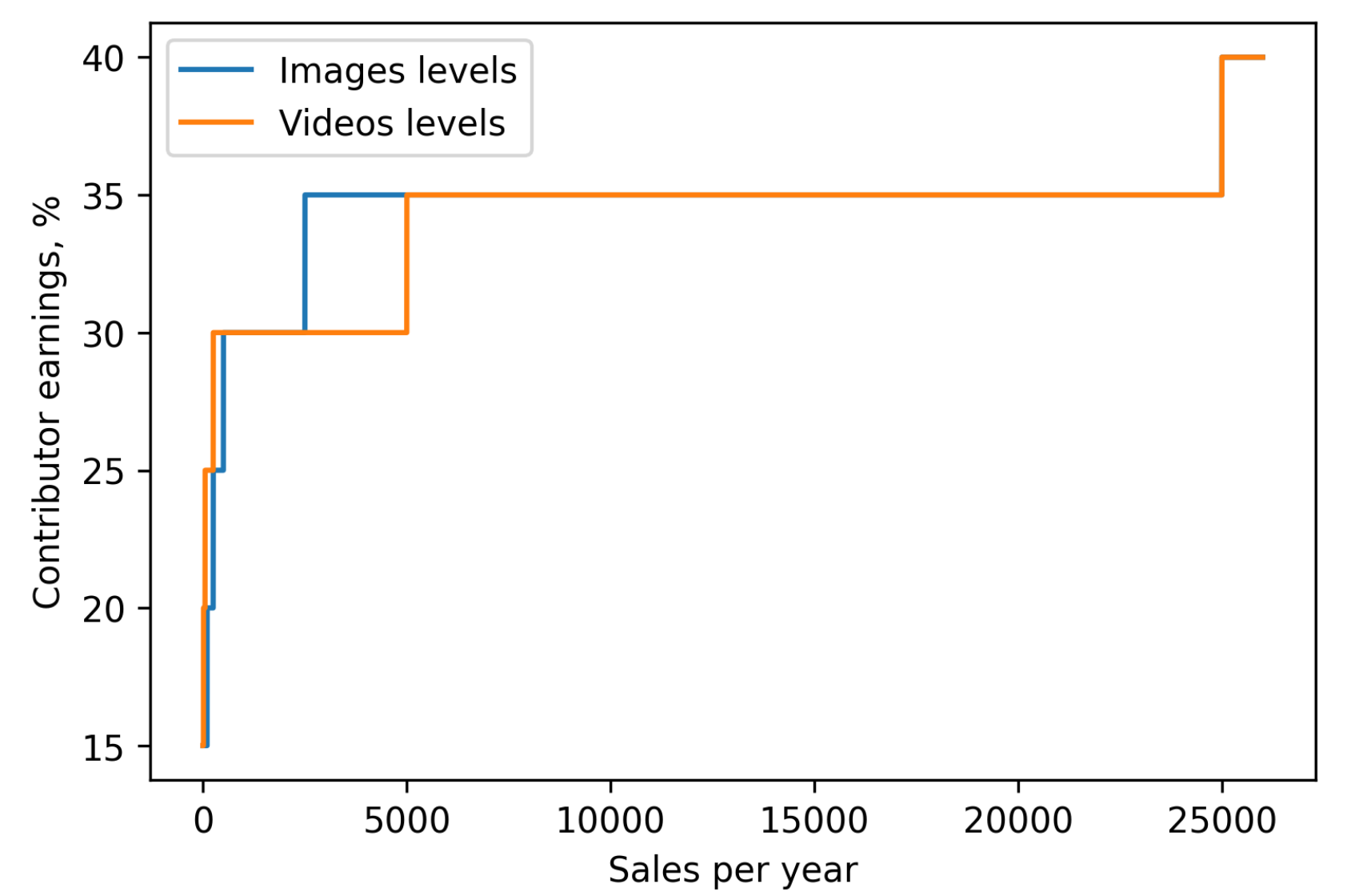
This is how it looks visually
Images
| Level | Number of image sales this calendar year | Royalty Rate |
|---|---|---|
| Level 1 | Up to 100 | 15% |
| Level 2 | 101 to 250 | 20% |
| Level 3 | 251 to 500 | 25% |
| Level 4 | 501 to 2,500 | 30% |
| Level 5 | 2,501 to 25,000 | 35% |
| Level 6 | Over 25,000 | 40% |
Purely theoretically, this tiered structure serves as an incentive for contributors to consistently produce high-quality and in-demand content that attracts a higher volume of downloads. But practically speaking, it’s of course designed to help Shutterstock Inc. to earn more money.
Videos
Similarly, Shutterstock employs a comparable six-level earnings system for video content. While the ultimate royalty percentage at the highest level is the same for both images and videos (40%), it’s much more favorable for contributors with lower number of sales.
| Level | Number of video sales this calendar year | Royalty Rate |
|---|---|---|
| Level 1 | Up to 10 | 15% |
| Level 2 | 11 to 50 | 20% |
| Level 3 | 51 to 250 | 25% |
| Level 4 | 251 to 5,000 | 30% |
| Level 5 | 5,001 to 25,000 | 35% |
| Level 6 | 25,000+ | 40% |
Interactive tool
There’s an interactive earnings tool where you can play to see what percentage you will actually earn, depending on the number of downloads each month:
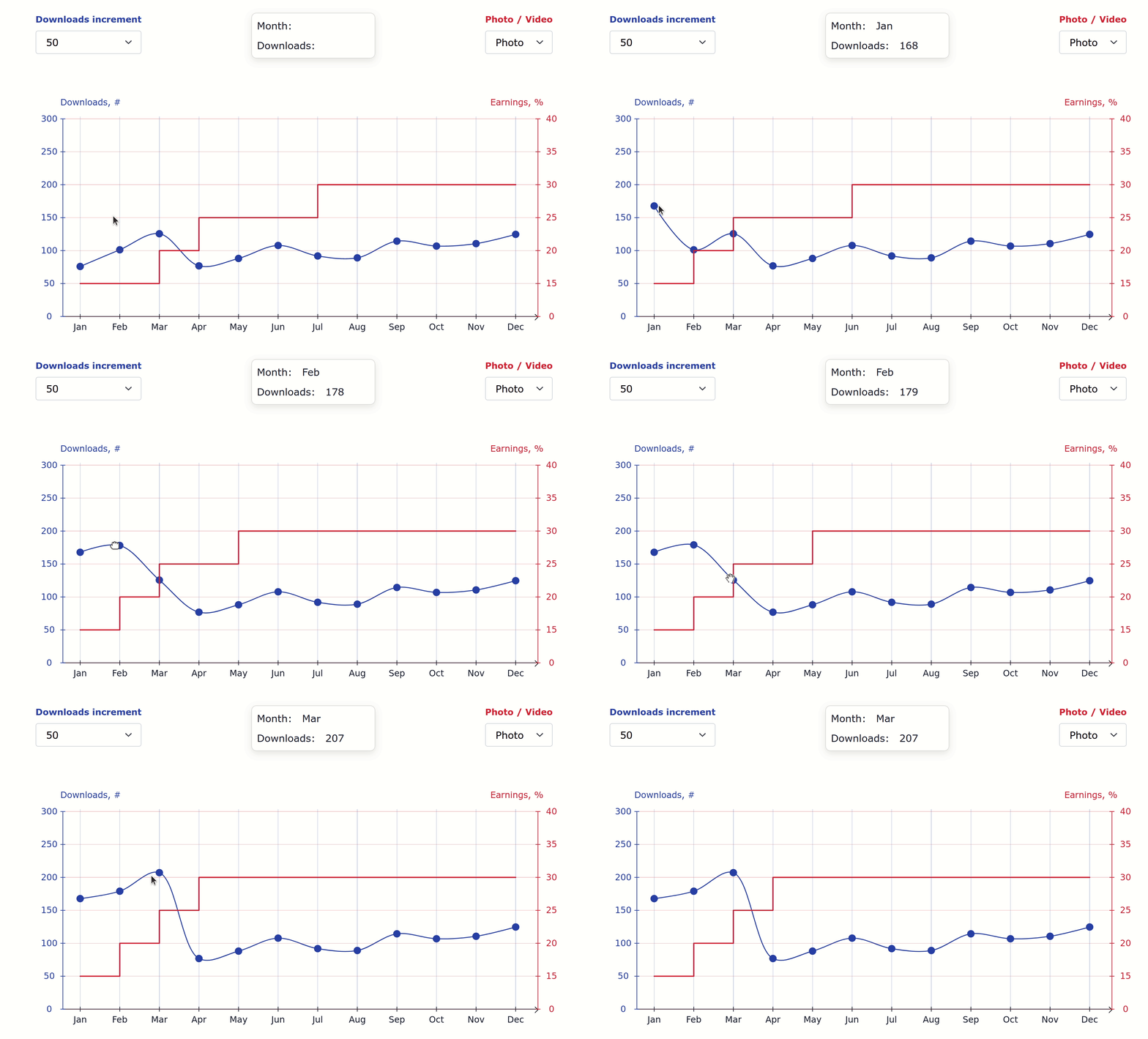
Earnings calculator (click to open)
Impact of customer’s tier and license type
On Shutterstock, different customer plans come with varying price points and download allowances, which subsequently affect the effective price per image or video and, consequently, the percentage earned by the contributor.
Plans can be broadly categorized as subscriptions (annual and monthly) and on-demand packs:
- Annual subscription plans typically offer the lowest per-image cost for customers who require a consistent supply of content over a longer period
- Monthly subscriptions provide more flexibility for users with fluctuating needs
- On-demand packs allow customers to purchase a specific number of downloads that they can use within a defined time frame without a recurring commitment
- The all-new (for 2025) Unlimited downloads plan is what it says on paper: unlimited downloads for a fixed subscription fee (details below)
In addition to the subscription plan, the type of license purchased by the customer also influences contributor earnings. Shutterstock primarily offers two types of licenses: Standard and Enhanced.
- The Standard License caters to most common creative and usage requirements, such as web and app advertising, e-publications, social media use, and small film productions with budgets under
$10,000. - The Enhanced License grants significantly broader usage rights, allowing for use in merchandise, web templates, print templates, commercial spaces, and productions with unlimited budgets.
Examples of customer purchases
NOTE: example image and video data on the 2 pictures below is sourced from Jamo’s blogpost. Check it out for more details.
Image download earnings
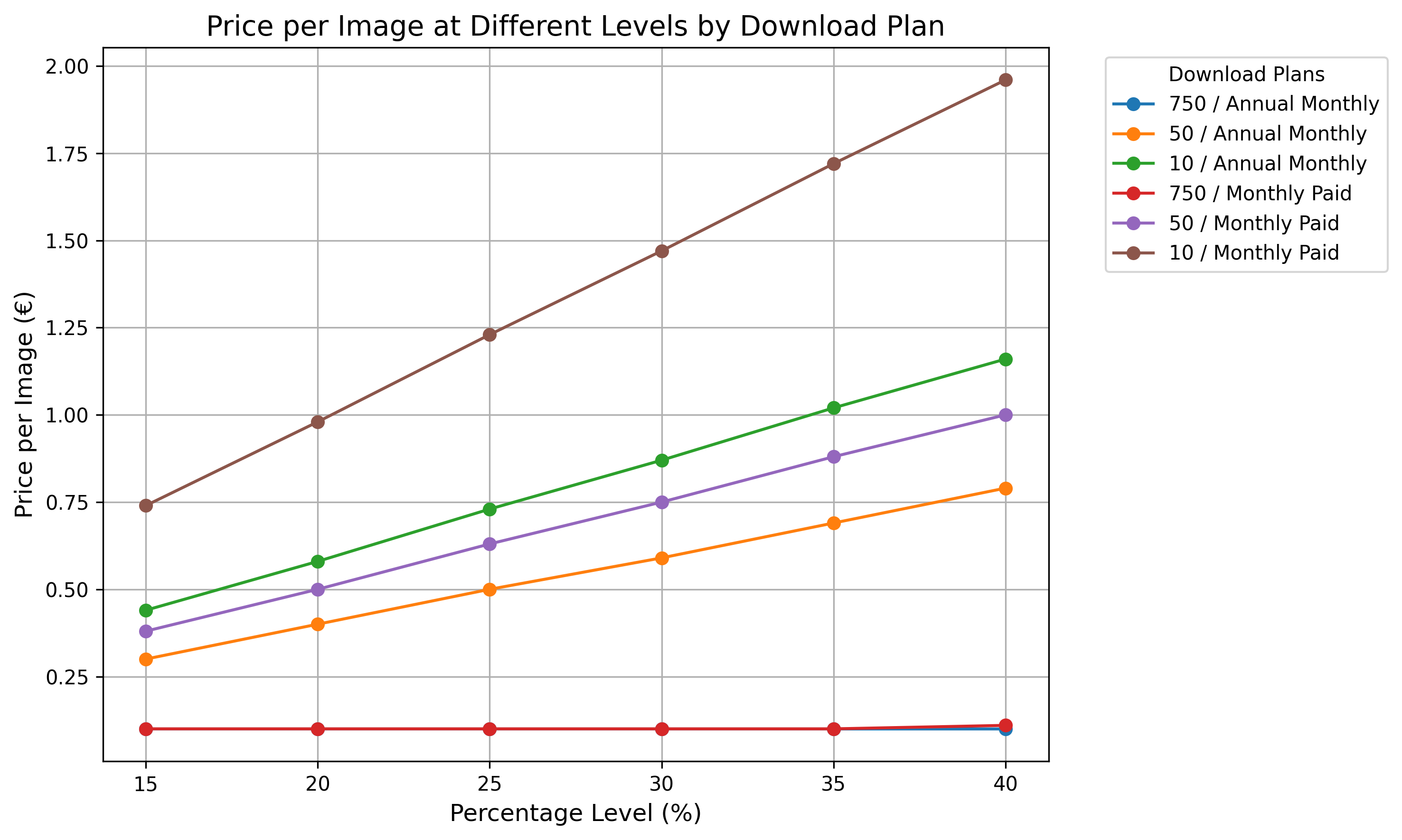
Earnings with different royalty levels on image purchases
Video download earnings
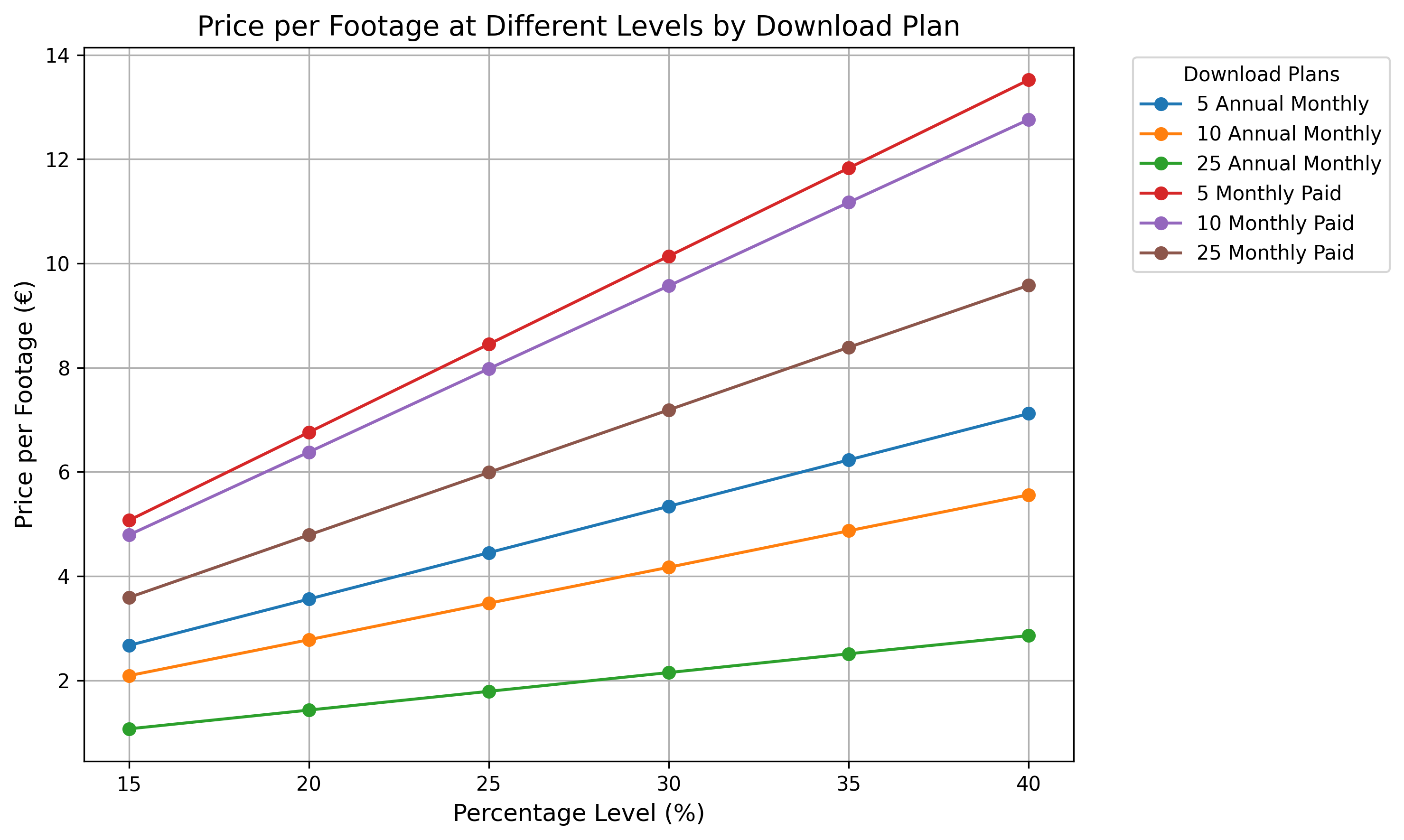
Earnings with different royalty levels on video purchases
Important considerations
Notably, even if a customer purchases an on-demand pack or a subscription but does not utilize all the downloads included, the contributor’s commission is still calculated based on the price per asset assuming full usage of the pack or subscription. For instance, if a customer buys a 10-images-per-month subscription for $49, the price per image is considered $4.90 for the purpose of calculating the contributor’s earnings percentage, regardless of how many images the customer actually downloads from their monthly allotment. Needless to say, hope you didn’t expect otherwise from Shutterstock.
Unlimited download model
In April 2025 Shutterstock introduced a pilot program, where customers can subscribe to “Unlimited downloads plan” and contributors will receive 50% of profits. Citing Shuttestock:
your earnings as a Contributor are tied to how much money each subscriber spends and how much they use your content. We look at each subscriber separately and calculate your share of 50% of their Net Revenue based on how important your items were to them.
In this case, as Alex states, income will not anymore depend on a fixed royalty rate, but will depend on customer behavior.
Note, while this model is an experiment, Shutterstock allows you to opt-out, which might be a sensible thing to do if your current earnings are satisfactory.
Other compensation
Exclusivity
Shutterstock’s standard agreement with its contributors is explicitly non-exclusive. This means, beyond anything else, that there’s no extra payment for “exclusives”. Contributors are not obligated to offer their content solely on the Shutterstock platform and are free to market their work on other websites or through any other means, even those that directly compete with Shutterstock. In fact, it wouldn’t be wise not to.
There is, however, a specific exception to this non-exclusive policy in the form of the “On the Red Carpet Program”. Content submitted under this particular program is subject to a two-year exclusivity period, but this should not concern most of contributors reading this.
Contributor Fund (aka AI training compensation)
There are mostly two use cases:
- Shutterstock licenses its datasets for other companies for AI training (for example, you can find them on Amazon Web Services) for a fee.
- Shutterstock uses your files to train it’s own AI that customers can use to generate or modify existing assets.
Conditions of Data Licensing (compensation for AI training) at Shutterstock are extremely foggy, to put it lightly. Shutterstock mentions that contributors receive around 20% of “corporate royalties” that Shutterstock receives itself for the case of sub-licensing datasets, but of course, we will never know how much exactly they received. As for AI training for Shutterstock itself, you will be compensated something when customers use the model, which your assets, among others, were used to train. However, this compensation is far smaller than the one you get if the customer licenses your work directly.
Note that you can opt-out from Data Licensing in your contributor account’s settings if you don’t want to help train Shutterstock’s (and other companies) AI models on your files.
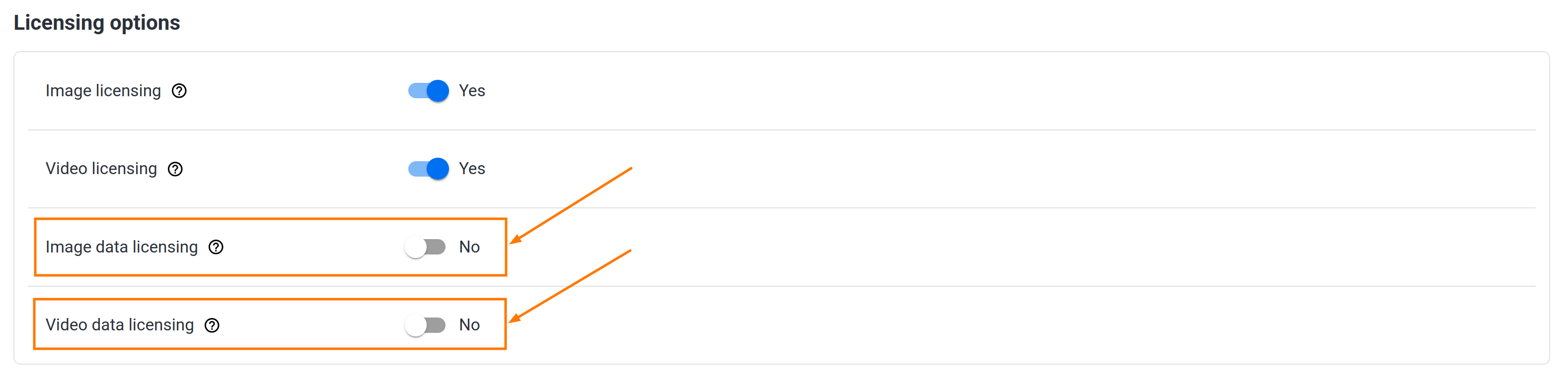
Options to opt-out (or opt-in) to Data Licensing in Account settings
AI part is very much unexplored territory and Shutterstock, just like other agencies, still experiments with different compensation structures in order to implement “responsible AI” correctly. Expect changes in this domain.
Referral program
Shutterstock also offers a referral program that allows contributors to earn additional income by referring new customers or other contributors to the platform. By sharing referral links, contributors can earn a commission on the sales or earnings generated by those they refer. For new referred customers, you can earn 20% of their first payment, but not more than $200. For referred contributors, for the first two years of their account, you can earn $0.04 per their picture sales and 10% for video sales.
On a personal note, the referral program is one of the most legit and useful additional “free” income streams you may get on microstocks, beyond “business as usual” work. Some people even scale it significantly, offering mentorship for newbies in exchange for the latter registering through their referral link.
Direct buyout
In some specific instances, Shutterstock might directly approach a contributor with an offer to acquire full copyright transfer of a particular asset for a significant commission, often with a request for temporary exclusivity for that specific asset to fulfill a client’s need. These instances are typically rare and involve individual negotiations. There were cases when Shutterstock purchased a part of a portfolio of a contributor, even from some other bloggers you may know, but they also signed a Non-Disclosure Agreement during the deal so nobody talks about that publicly.
Receiving payments
Shutterstock has a minimum payout threshold that contributors must meet before they can receive their earnings. Currently, this minimum payout amount is $25 USD. Contributors also have the option to set a higher minimum payout threshold in their account settings, ranging up to a maximum of $2000.
Shutterstock offers several methods for contributors to receive their payments, including PayPal, Skrill, and Payoneer. To be eligible for payment, contributors are required to have a completed tax form on file with Shutterstock. Payments are typically processed and issued between the 7th and the 15th of each month. However, it’s important to note that for new contributor accounts originating from certain regions identified as “high-fraud areas”, a 90-day waiting period may be applied to the payout guidelines. During this period, contributors can still submit content and generate sales, but they will only become eligible to receive their first payment 90 days after their first image or video clip is approved.
Payouts are calculated automatically and contributors do not need to manually request their payments once they have met the necessary requirements.
How much contributors actually earn
Here we can pull actual data from the 2024 survey just to see what is the bottom line.
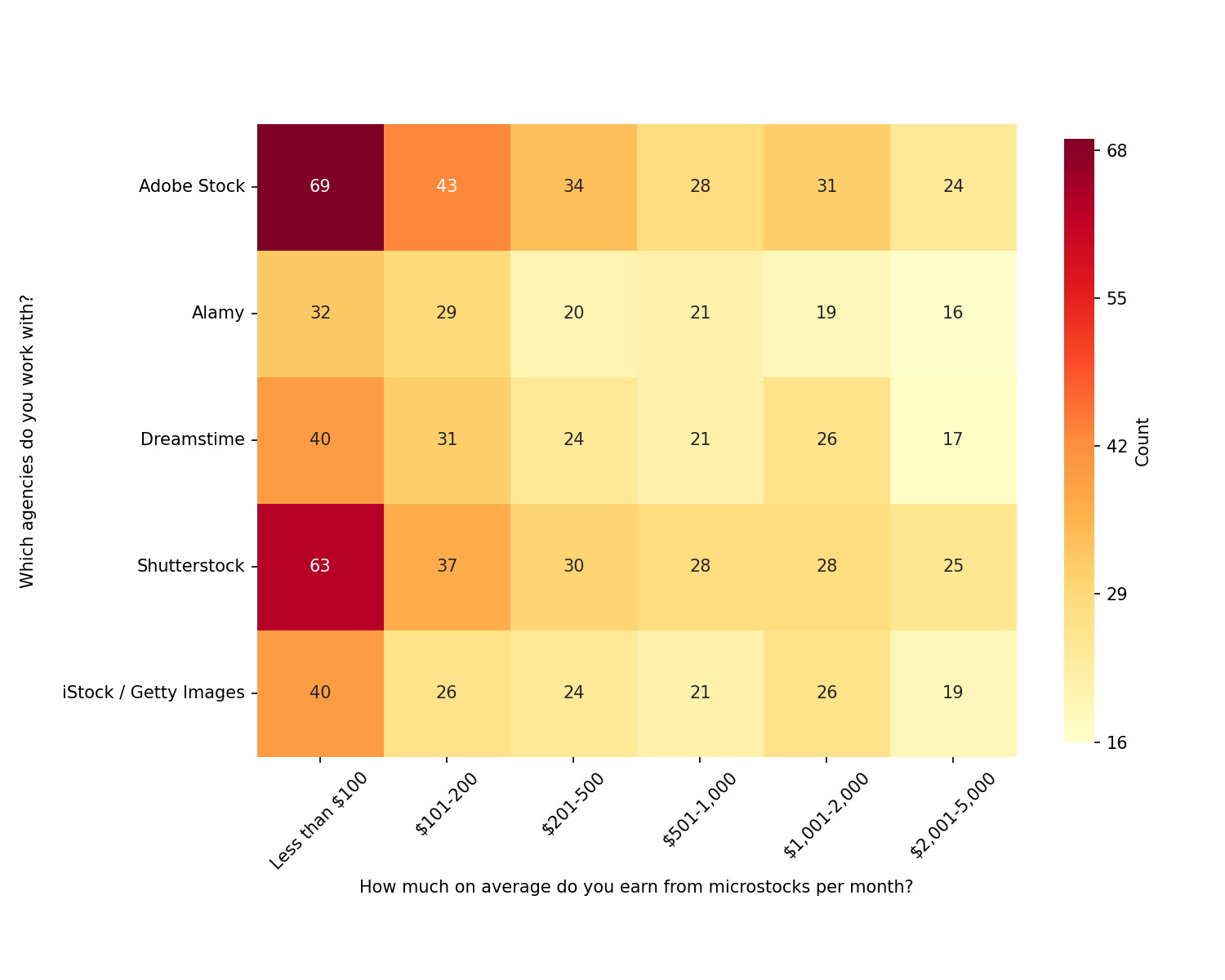
Earnings on Shutterstock compared with others
While Shutterstock and Adobe Stock are home to many low-earners (first column - less than $100), data shows that it’s easier (judging by the number of people who managed that) to earn more money (higher tiers) than on other agencies. You can see that after breaking out of low-income zone, Shutterstock allows for consistent growth (about equal number of people in other tiers), very similar to Adobe Stock.
So does that mean that this complicated royalty mess actually works out for some?