A few years ago Adobe Stock started taking over Shutterstock as a top agency (in terms of contributor earnings), after the latter did its earnings restructuring in 2020. This is also reflected in 2024 survey where Adobe was number 1 agency with 15.4% contributors, topping Shutterstock and Dreamstime. Also, in my opinion, Adobe Stock offers more unique opportunities for contributors: it accepts unique kinds of content (3D, templates etc.), offers free collection bonuses, free access to the Creative Cloud suite and just in general royalties structure sucks less than the competition. Chances are, you’re not in the know of all of these opportunities.
Royalties structure
Adobe Stock operates on a percentage-based royalty system where contributors receive a fixed percentage of the net sale price based on asset type
- Photos, Vectors, and Illustrations:
33%of the net sale price - Videos:
35%of the net sale price
The “percentage of what” is the complicated part here. Contributors earn the same percentage on any purchase, but actual payout per download depends on the customer’s purchase type (more on that below).
Contributor’s tiers (minimum royalty)
All contributors start at the same 33%/35% rate, but Adobe rewards high-volume contributors with bonuses and minimum payouts. Under large-subscription plans, a minimum royalty per license applies based on lifetime sales volume:
| Lifetime sales | Minimum royalty (per sale) |
|---|---|
| 0–999 downloads | $0.33 |
| 1,000–9,999 downloads | $0.36 |
| over 10,000 downloads | $0.38 |
So, very active contributors (10K+ sales) are guaranteed at least $0.38 each, whereas new contributors have a floor of $0.33. This logic is a little bit similar to what used to be the case on Shutterstock pre-2020, so old-timers will “feel at home” with this logic.
You may notice this is in stark contrast to Shutterstock where the minimum download can yield as little as $0.1 (yes, that is 10 cents).
Impact of customer pricing plans
Adobe Stock offers a variety of purchasing options for customers, which directly influences the amount a contributor earns per download (just to be clear, the percentage does not change, only what percentage is applied on changes).
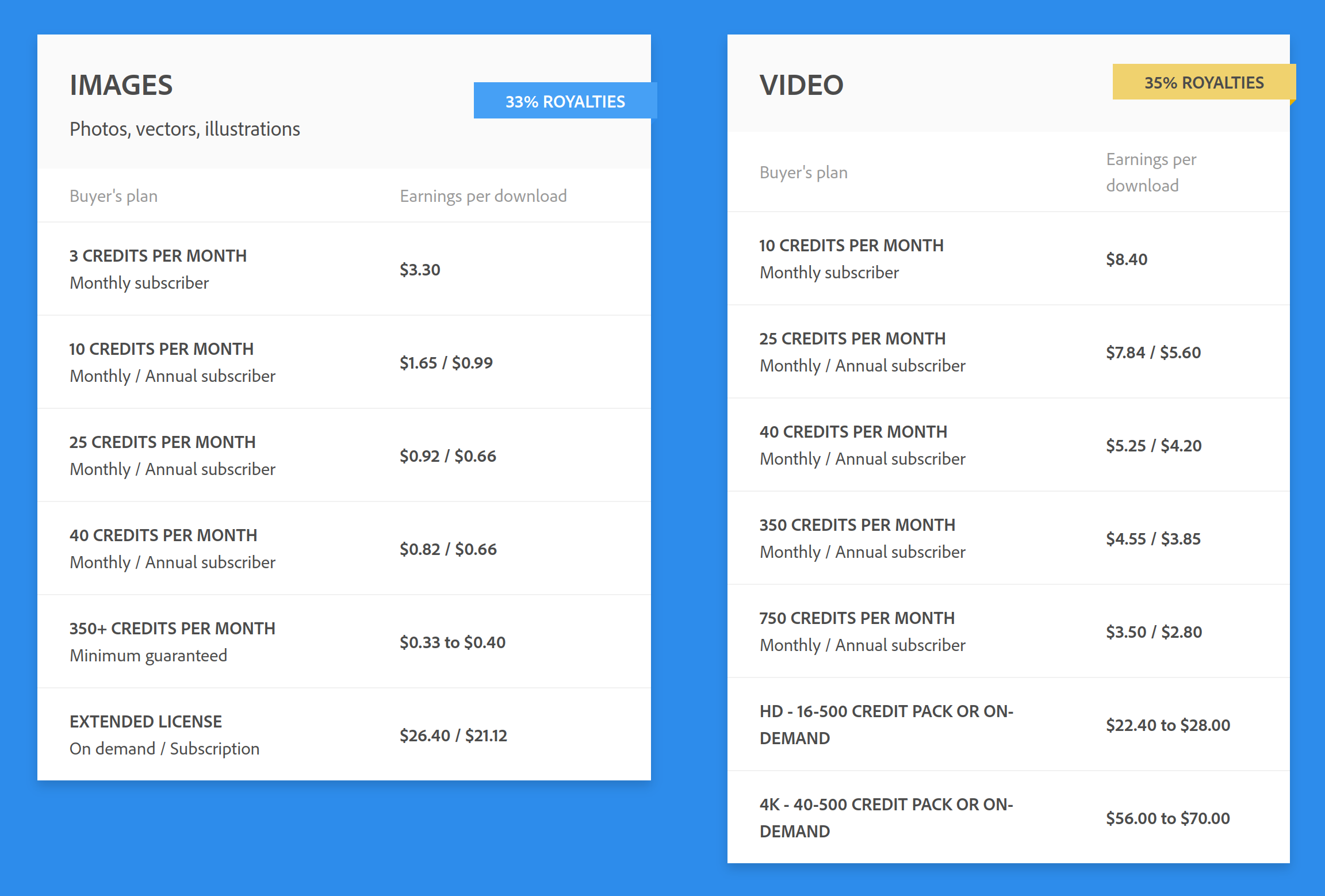
Earnings per download are based on pricing for US customers.
Standard plans (subscription, on-demand credits)
When a customer uses credits to license your asset, your earnings are a percentage of the value of those credits. These credits may come from subscription and on-demand (direct purchases) plans. Generally, the more assets a customer commits to per month, the lower the price per asset, and consequently, the lower the royalty per download for the contributor. For example, a download from a customer on a $29.99/month plan for 10 assets would yield a different earning than a download from a customer on a more extensive plan.
Extended Licenses
For an additional fee, customers can purchase an Extended License, which grants them broader usage rights, such as for merchandise. Contributors receive their standard royalty percentage (33%) of the Extended License price, which can significantly boost earnings from a single transaction.
Enterprise/Team plans
As with all enterprise deals, Adobe’s large customers have custom plans. In late 2024 Adobe introduced “Pro Edition” for Teams/Enterprise – unlimited standard downloads bundled with CC apps. For Teams plans, assets carry an enhanced license; for Enterprise, an extended license - but contributor royalty remains 33%. Other non-standard plans (Adobe Express, etc.) either pay 33/35% or are flat-rate deals.
In all cases, the contributor share is a fixed percentage of the net sale price.
Free trials and promotions yield no extra bonus: Adobe pays the listed royalty based on the actual purchase price or credits spent.
Niche content types
Although Adobe Stock does not publish rates publicly, you can get paid more if you are an expert in:
- Audio and Music (Audio assets follow standard licensing terms and are integrated into video editing workflows through Premiere Pro)
- Templates and Motion Graphics (also integrate directly into Adobe Creative Cloud applications)
- 3D Assets (models, materials, and lights with integration into Adobe Dimension)
As you can notice, those are all assets for specialized Adobe apps. And, as a rule of thumb, rare and specialized things cost more.
Other payments, bonuses and remuneration
Free Collection payments
Contributors may nominate assets (usually the ones that didn’t sell well) for Adobe’s Free Collection. If accepted, each such asset is paid a one-time credit fee. Credits are converted 1:1 to USD at payout. Adobe explicitly states no royalty is paid for Free Collection downloads beyond these fixed payments.
These fixed payments are:
- Design Templates: 5 credits (one-year period)
- Photos: 4 credits (one-year) or 10 credits (perpetual)
- Icons: 1 credit or 2 credits
- Vectors/Illustrations are not separately listed under free programs and count as photos
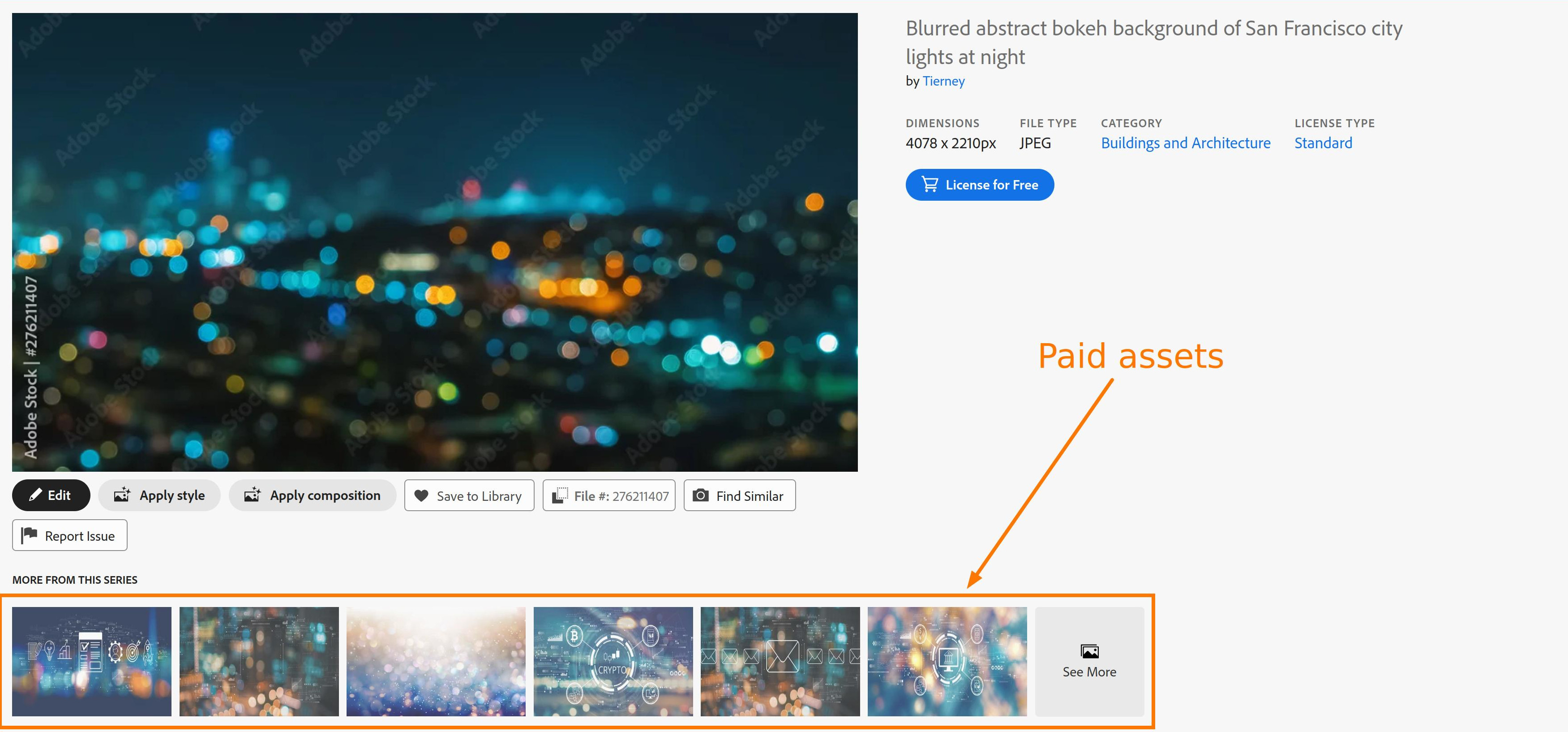
Contributor's paid assets advertised right next the ones from free collection
Free collection participation is a unique win-win opportunity for contributors as not only do they get paid at least something for assets that were not sold anyway, but also they get “free marketing” as their paid assets are effectively advertised right next to the free ones.
AI contributor bonus (Firefly)
Adobe uses many Stock images to train its Firefly generative AI. The first Firefly bonus payments began in September 2023 and Adobe continues this program annually, providing additional revenue for contributors whose work contributes to AI model development. This is similar to what Shutterstock and other agencies with image generators are doing.
The bonus amount is not a fixed rate and is based on a contributor’s “all-time intellectual property licensing earnings and the number of their approved assets”. This means that contributors with a long history of successful sales and a large, approved portfolio are likely to receive a larger bonus.
Worth noting that in this relationship Adobe gains more than its contributors, as, with time, Firefly model becomes better (currently it’s still not that great). But contributor’s bonuses are smaller than those from direct sales.
Annual contributor bonus program
Active contributors get a free access to Adobe Creative Cloud
This is a non-monetary (albeit still monetary in a certain sense) payback in the form of a free subscription to certain apps from the Creative Cloud suite. In my opinion, it’s one of the best bonuses among the microstock agencies, because it’s likely you’re already using some Adobe apps to create assets anyways. This way you can get them legally for free.
Contributors must upload and have approved at least 150 new assets during the calendar year to qualify (video downloads count as three downloads)
Qualification: The bonus is based on the number of downloads your portfolio receives in a calendar year. The tiers are subject to change, but generally look like this:
- Lower Tier: A certain number of downloads (e.g.,
250+) may qualify you for a free subscription to a single Adobe app like Photoshop or Illustrator. - Higher Tier: A significantly higher number of downloads (e.g.,
6,000+) can earn you a free one-year subscription to the full Creative Cloud suite.
Free access to Porfolio
As a “permanent” non-monetary bonus, Adobe Stock contributors have free access to Portfolio. “Porfolio” allows you to build a free website to showcase your work (you can even sell it through it with sales managed via Adobe Stock).
Premium collection (invitation only)
A small group of invited artists contributes to Adobe’s hand-curated Premium collection (an alternative to Shutterstock’s Offset). Although Shutterstock abandoned its efforts to maintain a separate premium content collection, Adobe is still playing this game. Anecdotal evidence shows very high payouts: one contributor reported earning ~€1,600 in one year from just 65 premium images – noting that each sale often paid "€50 to €100".
Supplemental Work / Content Missions
Adobe offers supplemental work requests for specific content needs, providing additional earning opportunities beyond standard submissions. These requests involve confidential projects with predetermined compensation rates. These are similar to Shutterstock Custom.
Adobe Missions offers selected contributors opportunities to earn extra income by creating content for specific projects, particularly AI and machine learning applications. These missions typically involve:
- Submitting 400-600 images per mission for individual subjects
- Creating diverse datasets with varied angles, expressions, and poses
- Receiving fixed payments for approved mission submissions
Mission content does not appear on Adobe Stock for licensing but provides upfront compensation for specialized content creation.
Exclusivity
Adobe does not have an exclusivity program – all contributors sign non-exclusive agreements. Pre-2019 Fotolia (in case you don’t know, Fotolia became Adobe Stock) had different exclusive/non-exclusive tiers, but Adobe Stock standardized all contributors at 33%/35%.
Referral program
While Adobe Stock does not offer a direct contributor referral program (like the Shutterstock, Dreamstime and others), the broader Adobe Affiliate Program allows the promotion of various Adobe services (starting wtih Creative Cloud, which is the main cash cow for Adobe). Worth noting that it’s available through quite outdated (even for 2000s!) and shady-looking website of Partnerize.
Receiving payments
Contributors can request payouts once they meet specific criteria:
- Minimum balance of
$25in royalties - At least 45 days since the first sale
- Valid tax form on file (standard documents, just like on all other agencies)
- Verified payment account (PayPal, Payoneer, or Skrill)
All Adobe Stock contributor accounts are paid in US dollars regardless of location, with 1 credit equaling 1 USD . Payment methods vary by country, with Payoneer required in certain regions including Indonesia, South Africa, South Korea, and Turkey.
How much contributors actually earn
Here we can pull actual data from the 2024 survey just to see what is the bottom line.
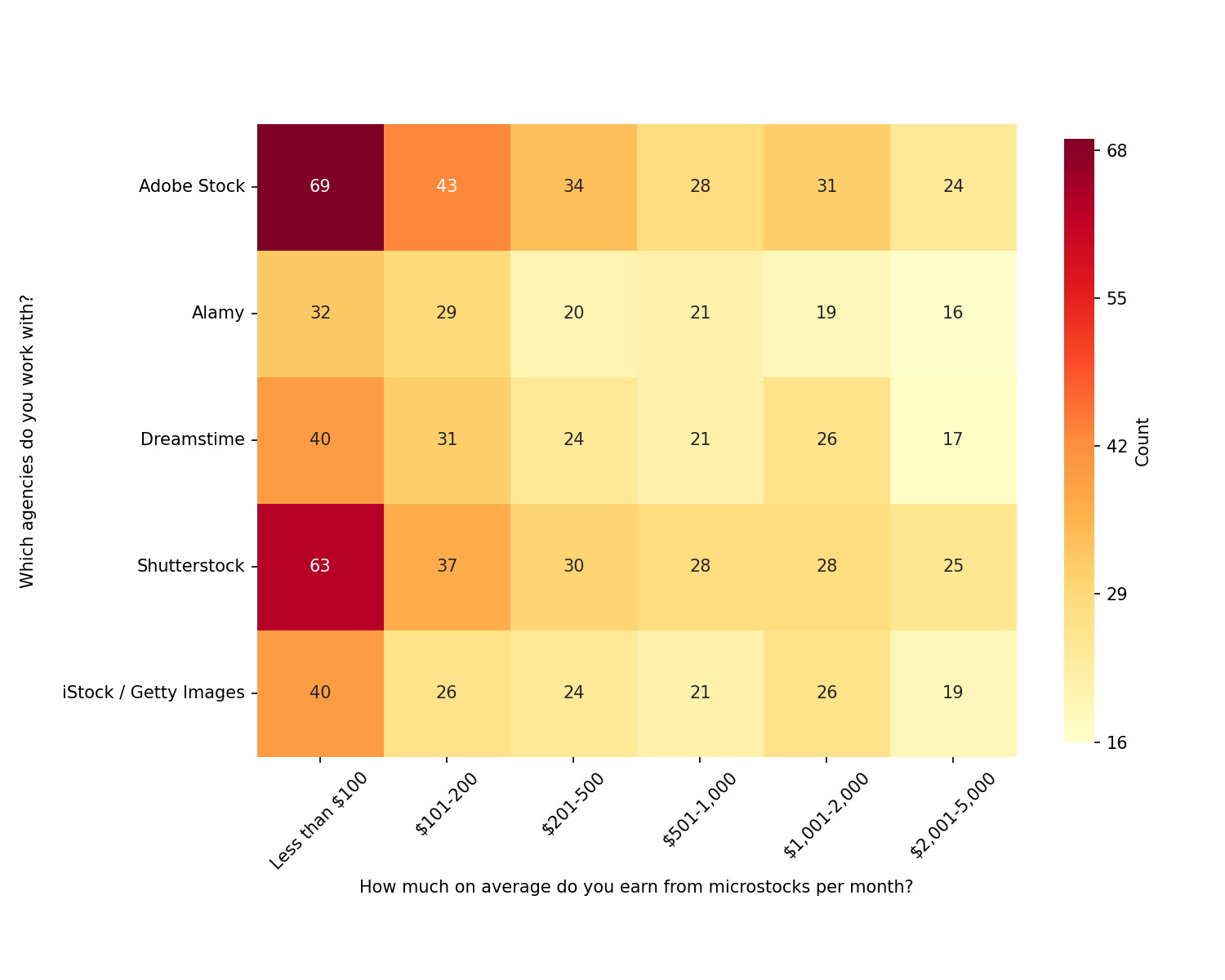
Earnings on Adobe Stock compared with others
Adobe Stock has a tiny bit more earners in all categories of monthly income, starting with a lot of low-earners (first column - less than $100). Data shows that it’s easier (judging by the number of people who managed that) to earn more money (higher tiers) than on other agencies (having a negligible edge over Shutterstock). In any case, Adobe Stock is home for the most of $1,000-2,000 monthly income bucket and matches Shutterstock for those over $2,000. Which, I think, is not coincidental.