On June 18, 2024 a user contacted Xpiks support with approximately this message (lightly edited):
My Adobe SFTP host credentials don’t work anymore. It worked a few days ago and I did not change anything.
Usually, we have relatively many users having an issue with Adobe upload because they have a different username and password for FTP access than those used for the website login, which is a good thing, but just not so obvious for many. However, this user’s problem was different: after looking through the diagnostic logs and seeing 530: Login Denied, I was quick to conclude the mistake on the user’s behalf. A typo, regenerated credentials, compromised account - anything really could have gone wrong, just the Xpiks and SFTP protocol were not to blame.
But the user was adamant - things used to work before, no changes were made, the account was secure. As a last resort, trying it out in Filezilla (with the same result) proved that it’s not a fault of Xpiks. So we walked step by step through the process of how you usually get new Adobe Stock FTP credentials for upload. Log in to the website, open this and that and then… no credentials were shown. An obscure place, where they used to be for years, was just empty.
And this user was not alone. In fact, here’s a chart of Xpiks support requests with users contacting regarding upload problems to Adobe Stock:
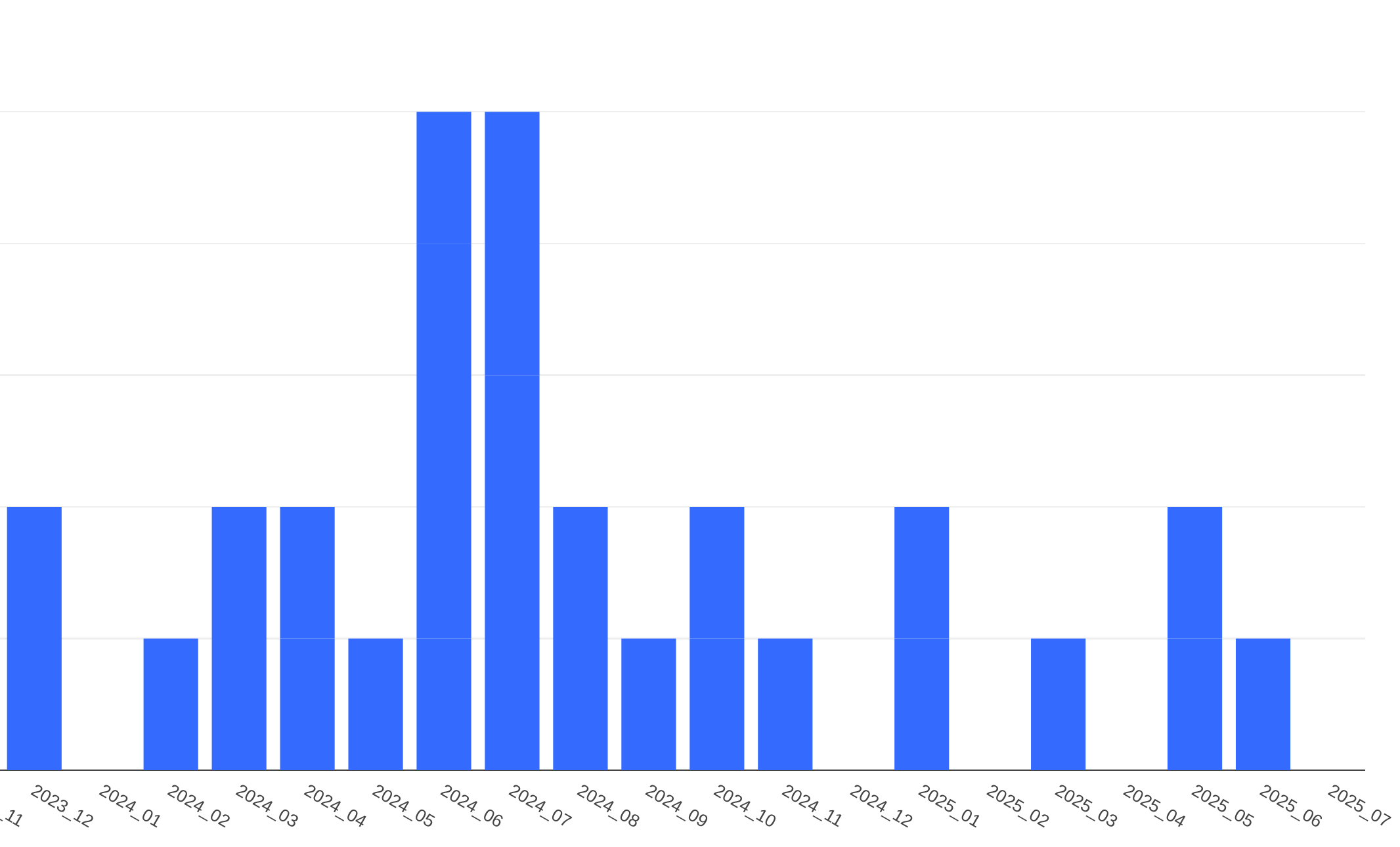
Xpiks support requests regarding Adobe. Can you guess when the problems began?
Support requests for Adobe Stock upload in June and July 2024 have more than doubled. There was only one thing common to those accounts: they were relatively new, and they were uploading pictures generated by AI.
Agencies on generative AI: “DO or do NOT”
With the boom of diffusion models in the early 2020s, generative AI was quickly and surely predicted to “kill stock photography”. But before “killing the industry”, it became a tool of choice for many of how to increase the size of their portfolio. Everybody knows that microstocks are a “numbers game” and “the more you have, the more you sell”. In fact, these beliefs are so deeply rooted that even after years of failures, there’re Reddit threads that ask “How many images i need to start selling well in adobe stock” (they are not asking, for some reason, about “what buyers need”, just about the number of images).
Anticipating the influx, agencies divided into two camps: those who “DO” and those who “do NOT”. Shutterstock (and it’s satelites like Pond5), Getty, Alamy were those who “do NOT”, while Adobe Stock, Dreamstime and few smaller and irrelevant agencies like Vecteezy decided to embrace the mess.
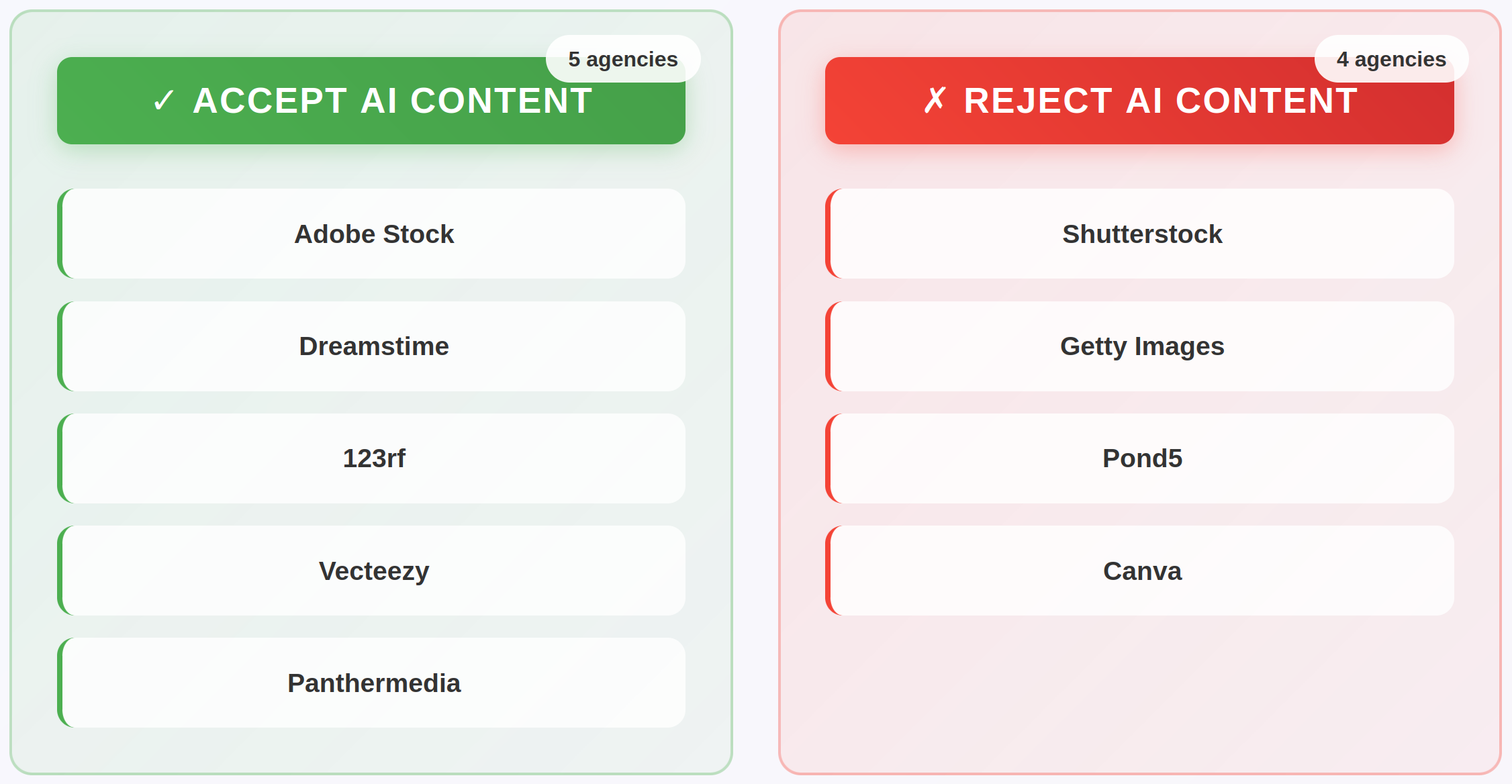
Agencies, roughly divided into two 'AI camps' (as of 2025)
Agencies pulling punches
It’s not clear if Adobe Stock and friends knew what they are signing up for, but here it goes. Many contributors decided to give generative AI a try. Selling images, automatically created with just your computer, sounded as lucrative as mining crypto coins a decade before. Within a matter of seconds (and a few bucks on Midjourney) you can copy the concept idea behind best-sellers in your niche and cut yourself a fraction of the pie. Or so they thought. But the thousands of freshly minted pictures went through Xpiks on their way to FTP servers and agency reviewers. And problems began.
Adobe Stock
Initially at Adobe, problems were limited to delayed and inconsistent reviewing, which MicrostockGroup forum users blamed AI reviewing for: one day the whole batch was accepted and the other time, nothing at all. That’s while being part of the same photo shoot. Reddit success stories of a few who achieved an “overnight success” by uploading their 10,000 generated assets and next week getting to stable $500/month income level fueled hopes of many others, who were not so lucky.
Fast forward 2 years, Adobe Stock was choking and they had to do something. Instead of defining and communicating clear rules of the game, they decided to employ shady tactics.
First retaliation was to pull the plug on FTP upload, which is the lifeblood of automation for everybody. The user, who contacted Xpiks support, was one of many to come who experienced that on their own skin. In fact, they decided to make everybody with new accounts to only upload via the website. They are not the first to make this limitation: it existed in some form on Freepik since forever, where you are granted FTP access only after the first 500 accepted files uploaded via browser. But Freepik declares it in the rules, and Adobe Stock did not.
Many have tried to contact Adobe’s support and the only response they got was “We cannot comment on that issue”. Adobe was doing it in the worst way possible, not only ruining trust, contributor experience, diluting the asset base for customers with insane amount of low-quality AI slop, but also being completely silent about it.
However, that was not enough. Users who spam with AI pictures do not give up if you limit them to browser upload only. Browsers nowadays are automatable with AI or just with your persistence and the flood of content continued. So the next thing Adobe did was to introduce content limits for everybody. Again, they did not explain the situation, but in May 2025, they limited the number of pictures per week that all users can upload. After the quota is reached, users have to wait until the next week. This has ruined workflows of many users who used to process large batches of traditional non-AI artworks in a single go.
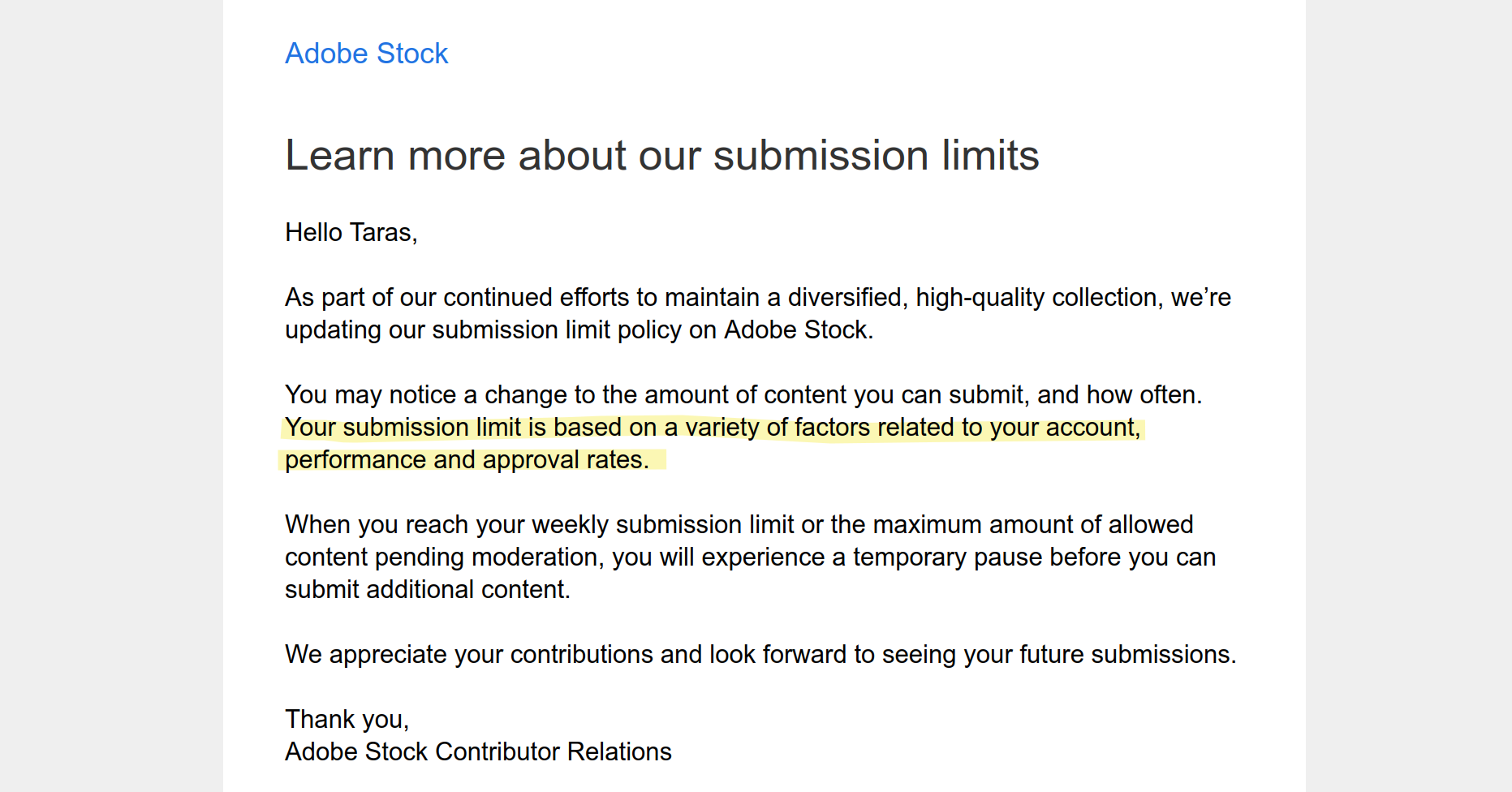
A typical example of 'clear' and 'fearless' communication of Adobe Stock
Funny enough, Adobe made it so from the beginning that AI-generated content was clearly marked with a separate category and keywords. Had they explained the rules (and limited the number) of those kinds of uploads since the beginning, chances are, this humiliating situation wouldn’t even have developed.
Wirestock
Wirestock, a YCombinator-backed company that is desperately trying to push itself into the chain of middlemen between the creator and the customer, in addition to stock agencies, was also affected. They were hit by the flood of AI content and had to gradually decrease the “free submissions” limit from 300, when they introduced it in 2023, to 100 in 2024. That is, if your “approval rate” is higher than 85%, which is way too high for most. Their latest change to that is that those submissions are “free” only if you want to submit to Wirestock itself (since they are currently attempting to become an agency of itself). And if you want to submit to other agencies (which is how Wirestock started), you need to pay all the time.
Other agencies
Other agencies, that joined the bandwagon of greenlighting AI pictures, were not particularly selective before AI either, to put it lightly. From the larger ones, Dreamstime and 123rf had almost non-existent review processes for ages, mostly “taking everything in”. So their move not only did not raise eyebrows, but also, probably, yielded just a little bit more of nothing to all parties of the equation.
Has AI killed stock photography yet?
Stock photography, as an industry, is dying - everybody knows that. In fact, it’s “dying” since circa late 2000s, so much so, that, while “dying”, it manages to grow about 7.5% annually, based on the market research by “Market Research Intellect” (love the classic company name, btw - would make a “great” acronym too).
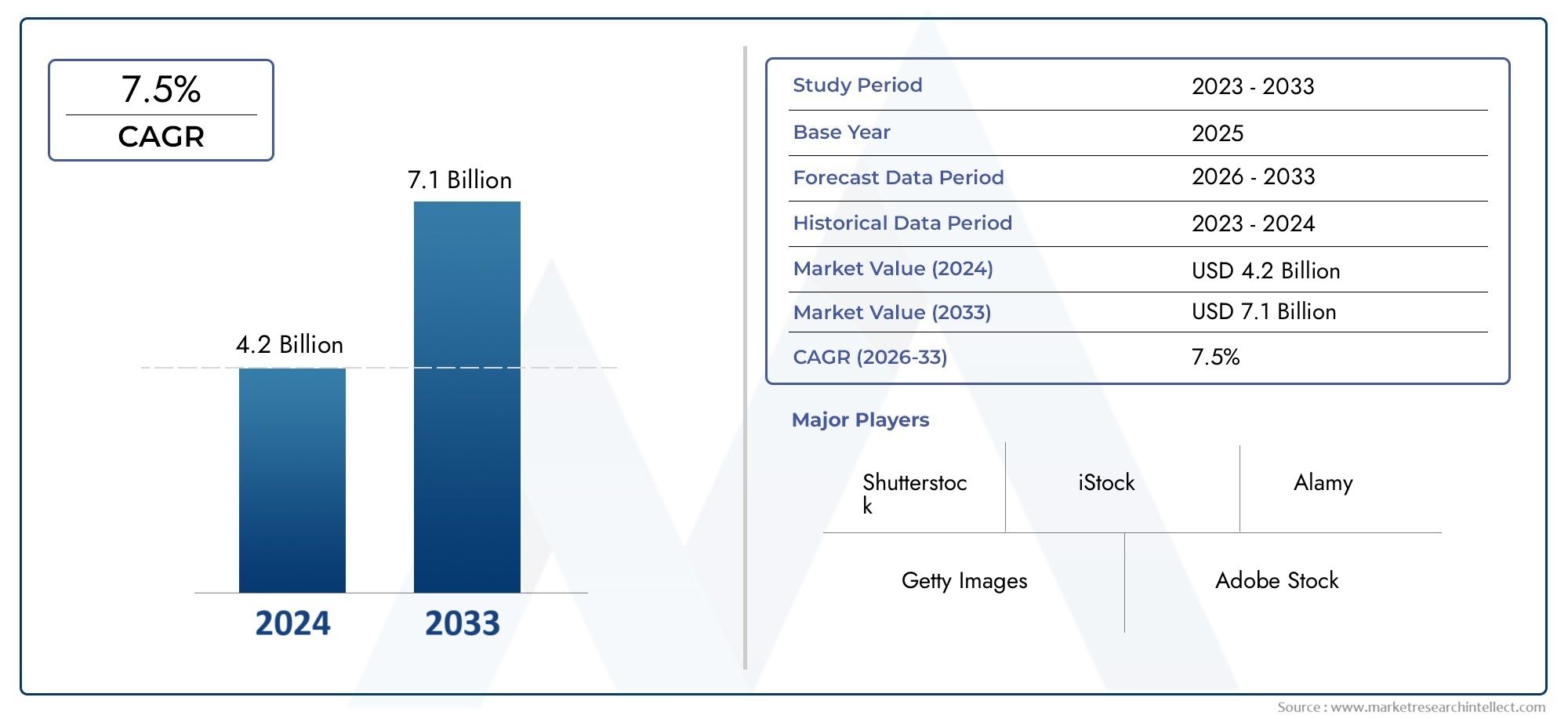
Stock photography, while 'dying', grows 7.5% year over year
But I diverged. It’s dying. Everybody knows that. But is AI killing it or what?
Jevons paradox
From Wiki:
In economics, the Jevons paradox occurs when technological advancements make a resource more efficient to use (thereby reducing the amount needed for a single application); however, as the cost of using the resource drops, if demand is highly price elastic, this results in overall demand increasing, causing total resource consumption to rise.
Which, to adapt for stock photography, means that even though it might become easier to create an asset, the demand for such assets actually might increase. And a funny thing about stock photography is that the demand for it actually grows (citing the above-mentioned research here):
- Every industry is being digitized, which drives demand for visual content. Content creators, bloggers, influencers, educators, and businesses all require a continuous supply of images to keep their digital presence engaging and fresh.
- E-Commerce is booming too, and online sellers need visually appealing product images, lifestyle visuals, and thematic images to market their listings effectively.
- Small and medium-sized enterprises often lack the resources to commission custom photography but still need visually rich marketing materials. Which, guess what, they can find on stock agencies.
Even so, a growing industry does not translate equally to growing contributor earnings.
FutureDemand is here, but it’s not equally distributed
Earnings do, in fact, grow for many people, as indicated in the 2024 survey, but definitely not for everyone. So if it’s not AI killing it, then what?
Real problems of microstocks
Problems with the stock photography industry have started long before AI was about to “kill it”. It was the oversaturation of the market, free asset libraries, and a general unsustainable business model (Rob Walling didn’t tell them that two-sided marketplaces are a tough business idea?).
The best example of how unsustainable this business model is, is the case of Shutterstock, which had to do a disastrous contributor earnings restructuring in 2020 in order to survive a couple more years while searching an acquisition. Which pushed it from being a clear top-1 most loved agency to “somewhere in the top-10”.
Retroactively, I’m amazed by this blogpost from circa 2020 (ironically called “Is Shutterstock worth it?”), where Fabio Nodari writes:
Stan Pavlovsky‘s (new CEO - note) move seems ideal for consolidating short-term earnings: reducing commissions makes the photographers run away. Still, the customers are not affected immediately, and it takes a few months before they start leaving since they can’t find the content they needed. Note that a percentage of Pavlovsky’s salary is linked to the value of the shares.
This could give shareholders time to see in the more immediate future that the business is generating profits and could be the ideal time to sell Shutterstock ultimately (or merge it) to another company.
Which is ultimately what happened, as, in 2025, Getty Images are now in talks of acquiring Shutterstock for ~$3.7B - all in a desperate attempt to fight Adobe (who is proliferating on Creative Cloud and can afford to sustain a stock agency “on the side”).
AI slop as a sign of bad taste online
Surprisingly enough, despite generative AI mostly stopping adding an extra finger to human hands, having AI content in social media, blogpost and ads is now perceived by many as “cheap” and vulgar. The surge of AI content has given more value to the “traditional”, for lack of better word, content.
Additionally, AI content has a number of other issues:
- it cannot replace what was previously less popular for contributors, editorial content that depicts specific real people or places,
- legal gray area makes it questionable for use by any larger or governmental organization (for example, just in May 2025, Disney and Universal decided to sue Midjourney for copyright infringement)
Which is to say, that generative AI content is unlikely to be blamed for the “death of microstocks”.
What about contributors
Accepting AI content has drawn the attention of thousands of new contributors, who, hoping to automate content creation and earn some money, caused some irritation for Adobe and a few others. However, old-timers are not so optimistic.
Every year, there’s a final straw that breaks some experienced contributor’s back, and many stop creating new content. It does not usually mean they leave completely since stock photography is one of those side hustles with a passive income that lasts for some time after you stop. However, by my estimate, in 2020 alone, many more quit due to Shutterstock changing the rules (specifically, by resetting contributors’ royalty rate on January 1st every year), than in the last few years due to “AI disruption”. However, things have changed.
Many contributors started searching for greener pastures by switching to video, which is believed to be more “AI-resistant” (particularly drone video) than photography or sibling business models, like Print-on-Demand, Fine Art or book cover photography. There are even those who self-host selling AI-only content (which, at first, sounds double impossible!).
For those who stay, the game didn’t get exceptionally tougher because of the “competing AI content”, but it did not make it easier either as the amount of noise grew. There’s a small relief in the abundance of new AI tools for editing, keywording, and uploading, but this is offset by ever-changing rules of the game, which agencies like Adobe Stock chicken out to even define.
Contributors are absolutely essential for agencies to acquire new up-to-date and relevant content. And not just for customers. Stock agencies are some of the largest providers of training data for AI, so if they piss off a critical mass of contributors, their datasets will rot fast enough. And when that happens, all agencies will have to do is to consume their own AI-generated content - until all originality collapses inward.